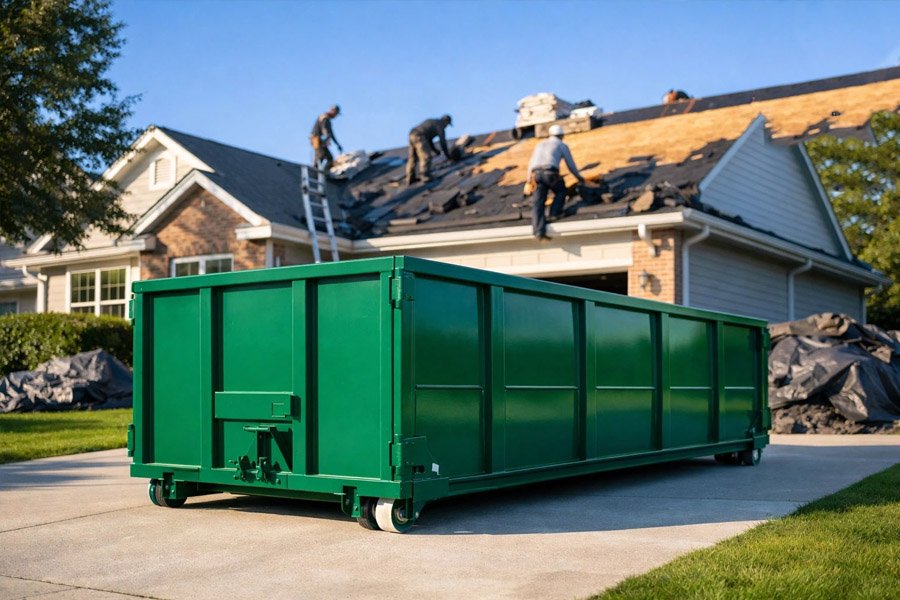
Roofing produces a shocking amount of debris. Homeowners are almost always surprised when the first section of old shingles comes off and the pile on the lawn is already knee-high. If you are planning a tear-off and handling disposal yourself, choosing the right container is one of the most important logistics decisions you will make. Order too small and you are paying for a second haul or scrambling to swap containers mid-job. Order too large and you are paying for air. Getting the size right the first time is the whole point of renting roofing dumpsters with a little math behind your order.
The good news is that roofing debris is fairly predictable. Unlike a kitchen gut job, where nobody really knows what is behind the walls, a roof’s waste volume can be estimated from its size, the number of existing shingle layers, and the material type. Here is how to work it out.
First, Understand Roofing Squares
Roofers do not measure roofs in square feet the way you might expect. They use squares. One square equals 100 square feet of roof surface. A typical suburban home has somewhere between 15 and 25 squares of roof, though larger homes and complex rooflines can push well past that.
To estimate your own roof size, you can start with your home’s footprint. A 2,000 square foot house does not have a 2,000 square foot roof, though. You need to account for pitch (steeper roofs have more surface area than their footprint) and overhangs. A quick rule of thumb: take your home’s footprint, add 10 to 20 percent for overhangs, then multiply by a pitch factor. For a moderately pitched roof (something like 6/12), that factor is about 1.12. If math is not your thing, most roofing material calculators online will do it from your address, or you can ask a roofing contractor for the square count during an estimate. Even if you plan to do the tear-off yourself, a free estimate call will usually get you the square number.
The Basic Volume Rule of Thumb
Here is the number most rental companies and roofers use: one roofing square of asphalt shingle tear-off debris fills roughly 1 cubic yard of container space, once you account for the underlayment, flashing, nails, and general packing inefficiency of shingles that arrive in the dumpster in irregular chunks.
That makes the math refreshingly simple for standard jobs:
- 15 square roof: about 15 cubic yards of debris
- 20 square roof: about 20 cubic yards
- 25 square roof: about 25 cubic yards
Since roll-off dumpsters come in standard sizes, usually 10, 20, 30, and 40 cubic yards, you can see why the 20-yard container is the workhorse of residential roofing jobs. It handles most single-layer tear-offs on average homes.
Adjust for the Number of Layers
The one-square-one-yard rule assumes a single layer of existing shingles. Many older homes have two layers, and some have three (which is the legal maximum in most building codes before a full tear-off is required). Each additional layer adds roughly the same volume again.
So a 20 square roof with two layers of shingles produces closer to 40 cubic yards of debris. That is a 40-yard container, or more realistically on a tight site, a 30-yard container plus a swap-out or a second smaller container staged partway through the job.
This is the single most common sizing mistake homeowners make. They count their squares, order the matching container, and forget that the roof has been recovering itself for thirty years. Before you order, either check the edge of the roof where you can see layering, or ask whoever inspected the roof how many layers are up there.
Adjust for Material Type
Asphalt shingles are the baseline, but not every roof is asphalt.
Architectural or dimensional shingles are thicker than old three-tab shingles and bulk up more in the container. If your roof has heavy architectural shingles, add 10 to 15 percent to your volume estimate.
Cedar shake is bulky but light. It fills space faster than asphalt, so bump your volume estimate up, but weight will not be your problem.
Tile and slate are the opposite story. They are dense and heavy, and weight becomes the limiting factor long before volume. Concrete tile tear-offs can exceed a container’s weight allowance with room to spare in the box. If you have a tile or slate roof, talk to the rental company directly about weight limits, and expect to use a larger container filled only partway, or multiple smaller containers, to stay legal on the road. Overweight containers get fined, and those fines get passed to the renter.
Metal roofing is the easiest disposal of all. It is light and can sometimes even be recycled rather than landfilled. A 10 or 15-yard container handles a surprising amount of metal panel tear-off.
Do Not Forget the Deck Work
If your tear-off involves replacing damaged plywood or OSB decking, that adds volume. Sheet goods do not pack well; they land flat and rigid and waste space. Figure roughly one extra cubic yard for every four to six sheets of decking you expect to replace. If you know the deck is soft in places but do not know the extent, mention it when ordering and consider going one size up.
A Quick Square-by-Square Reference Chart
For a single layer of asphalt shingles:
- 10 squares or fewer: 10-yard dumpster
- 11 to 20 squares: 20-yard dumpster
- 21 to 30 squares: 30-yard dumpster
- 31 to 40 squares: 40-yard dumpster
For two layers, roughly double the square count before reading the chart. So a 20 square roof with two layers reads as 40 squares, which points to a 40-yard container or a swap strategy.
When to Go One Size Up
Container space is like moving truck space. People are consistently better at underestimating what they have than overestimating it. Consider going one size up when:
- You have two or more shingle layers
- You are replacing decking
- The roof has valleys, dormers, or multiple levels that produce extra flashing and ridge waste
- The container will also collect gutters, downspouts, or other project debris
- Your driveway or street placement is difficult, making a second delivery expensive or disruptive
The cost difference between a 20 and 30 yard container is usually modest compared to the cost of a second delivery trip, a swap-out fee, or the lost weekend waiting for the swap while half your roof sits open to the weather.
A Few Practical Notes
Weight matters as much as size. Shingles are dense, and most rental agreements include a weight allowance with per-ton overage charges. A 20-yard container full of two-layer shingle debris can easily exceed 4 tons. Ask about the allowance before you sign.
Placement matters too. The container needs a clear drop zone, ideally on the driveway with plywood or boards protecting the surface, and away from overhead lines. If the dumpster has to sit in the street, check whether your city requires a permit.
Finally, keep the load clean. Roofing dumpsters are priced partly on where the debris can be taken. Pure shingle loads can often go to shingle recycling facilities at lower disposal rates. Mixing in household junk, paint cans, or appliances can turn a recyclable load into a contaminated one, which costs more and may violate your rental terms.
The Bottom Line
Count your squares, count your layers, and pick the container that matches. For most single-layer asphalt tear-offs on typical homes, a 20-yard dumpster is the answer. For two-layer roofs or larger houses, plan for 30 or 40 yards, or arrange a swap. Ten minutes of measuring and one honest look at your roof’s edge will save you the most expensive mistake in debris removal, which is ordering the wrong box and finding out halfway through the job.