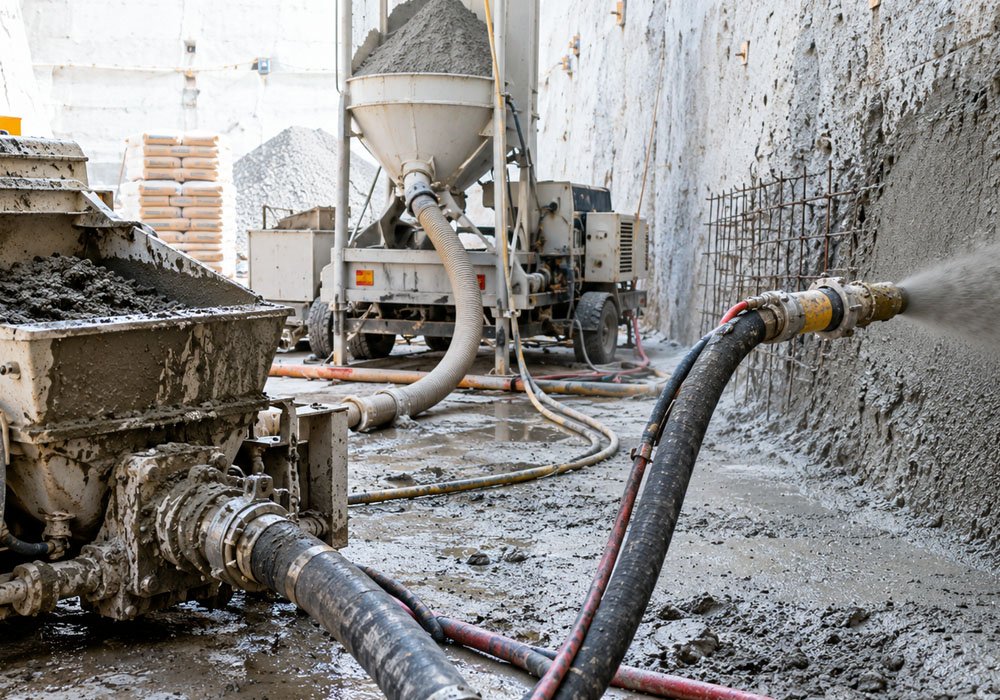
Concrete is usually poured. It arrives in a truck, flows into forms, and gets vibrated into place. Then there is shotcrete, which takes a different approach entirely. Instead of pouring, shotcrete is sprayed. Concrete or mortar is projected at high velocity onto a surface, where it compacts under its own impact and builds up in layers without forms. That single difference opens up applications that conventional forming cannot touch: steep slope faces, irregular rock surfaces, curved walls, and repairs where forming would be impractical or impossible.
But shotcrete is not one process. It comes in two distinct methods, wet-mix and dry-mix, and choosing between them affects equipment, crew composition, production rates, material quality control, and ultimately the finished product. Understanding how the two differ, and where each performs best, helps project teams match the method to the conditions instead of defaulting to whatever the subcontractor happens to run.
How Each Process Works
The difference between the two methods comes down to one question: where does the water get added?
In wet-mix shotcrete, concrete arrives at the nozzle already fully mixed, with all the water included. A ready-mix truck or batching plant produces a conventional concrete mix, which is pumped to the placement point. At the nozzle, compressed air and accelerator additives are injected to propel the material onto the receiving surface and control how quickly it sets. The mix design is essentially a pumpable concrete, usually with a fine aggregate gradation and fibers or silica fume when the application calls for them.
In dry-mix shotcrete, sometimes called gunite, the cement and aggregate are batched dry and conveyed through the delivery hose by compressed air. Water is introduced only at the nozzle, where the operator controls the flow. The dry material and water mix in the instant before the mixture hits the wall. The nozzleman has direct, real-time control over the water-cement ratio, adjusting it stroke by stroke based on what he sees coming off the surface.
That distinction drives nearly everything else about how the two processes compare.
Where Wet-Mix Shines
Wet-mix has become the default for higher-production work, and for good reason.
Volume. Wet-mix pumping can place large quantities of material quickly. Robotic nozzling equipment and steady pump delivery mean a well-organized wet-mix crew can produce far more square footage per shift than a dry-mix operation. On a soil nail wall with thousands of square feet of facing, that production difference translates directly into schedule.
Consistency. Because the mix is batched at a plant with controlled proportions and water content, every yard of material is essentially the same. Quality control is easier to document, and mix designs can be engineered for specific strength and durability requirements with the same confidence as conventional concrete.
Less rebound waste. Rebound is the material that bounces off the surface and falls to the ground instead of sticking. Wet-mix typically produces less rebound than dry-mix, which means less waste, less cleanup, and more of the batched material actually ending up in the wall.
Lower dust. With water already in the mix, wet-mix placement generates far less dust. That matters in tunnels, shafts, and confined work areas where air quality affects everyone on site.
Where Dry-Mix Holds Its Ground
Dry-mix is older technology, but it has not survived this long without real advantages.
Long-distance and flexible delivery. Dry material can be pushed through hoses over surprisingly long distances and around difficult paths, and the equipment is lighter and more portable than a concrete pump setup. On a remote slope access, a mountaintop repair, or a site where a pump truck simply cannot reach, dry-mix equipment can get material where it needs to go.
Intermittent placement. Wet-mix works best in continuous production. Once concrete is in the line, it needs to keep moving or the line plugs. Dry-mix can start and stop freely, placing a small patch here, another patch there, without wasting material or flushing lines. For repair work, small retaining structures, and spot stabilization, that flexibility is a genuine cost advantage.
Operator control of the water. The nozzleman’s ability to adjust water content moment to moment is a double-edged sword. In the hands of a skilled operator working variable surfaces, it allows fine tuning that wet-mix cannot match. Drier surfaces, wetter surfaces, and changing conditions can each be met with an adjusted mix at the nozzle. The caveat, of course, is that the quality depends heavily on the operator, which brings us to the human factor.
The Nozzleman Matters More Than the Method
Here is something both processes have in common: the person running the nozzle has an outsized influence on the finished product. Shotcrete is placed by impact, and the operator’s technique controls compaction, layer thickness, encapsulation of reinforcement, and surface finish. A poorly executed wet-mix placement will outperform nothing. A poorly executed dry-mix placement, with water content drifting too high or too low, can seriously compromise strength.
This is why experienced shotcrete crews, and specifiers who understand the process, put so much weight on nozzleman qualification and preconstruction testing. ACI has certification programs for nozzlemen precisely because the skill component is real and testable. When evaluating shotcrete on a project, the quality of the crew is arguably a bigger variable than the choice between wet and dry.
Matching the Process to Project Conditions
So which one fits your job? A few practical patterns:
- Large soil nail walls, shoring facings, and high-volume slope work generally favor wet-mix. Production speed and batch-plant consistency win on big square footages.
- Tunnel and shaft work often favors wet-mix for its lower dust and compatibility with robotic application, though dry-mix remains common in smaller tunnels and repair contexts.
- Remote or hard-to-access locations favor dry-mix when pumping equipment cannot practically reach the work.
- Small, intermittent, or repair-oriented placements favor dry-mix, where starting and stopping is easy and material waste on short runs is minimal.
- Projects with strict QC documentation requirements tend toward wet-mix, because plant-batched material is easier to test and certify consistently.
- Confined sites with limited staging may favor dry-mix, since the equipment footprint is smaller and no ready-mix delivery schedule is needed.
It is also worth noting that the two methods are not mutually exclusive. On complex projects, it is not unusual to see wet-mix handling the production walls while dry-mix handles detail patches and hard-to-reach repairs.
Questions to Ask Before You Specify
If you are writing a spec or evaluating bids, a few questions will clarify the right path. How many square feet or cubic yards need to be placed, and over what schedule? Can pumping equipment physically access the work? What are the strength and durability requirements, and how will acceptance testing be handled? How experienced is the proposed crew with the specific process being proposed? And what does the rebound and waste allowance look like in the pricing?
The answers usually point clearly toward one process or the other. When they do not, a specialty contractor with experience in both methods can run the comparison honestly, because they are not trying to force the project into the only process they own.
The Bottom Line
Wet-mix and dry-mix shotcrete are two ways of solving the same problem: placing concrete where forms cannot go. Wet-mix brings production speed, consistency, and cleaner placement. Dry-mix brings flexibility, portability, and nozzle-level control. Neither is universally better. The right choice depends on the volume of work, the access, the schedule, and the quality demands of the project.
What matters most is that the decision gets made deliberately, based on project conditions, rather than by default. Shotcrete done well is one of the most versatile tools in geotechnical and structural construction. Done carelessly, with the wrong process for the conditions, it creates problems that are expensive to fix. A little up front evaluation of which process fits is one of the cheaper insurance policies on the job.