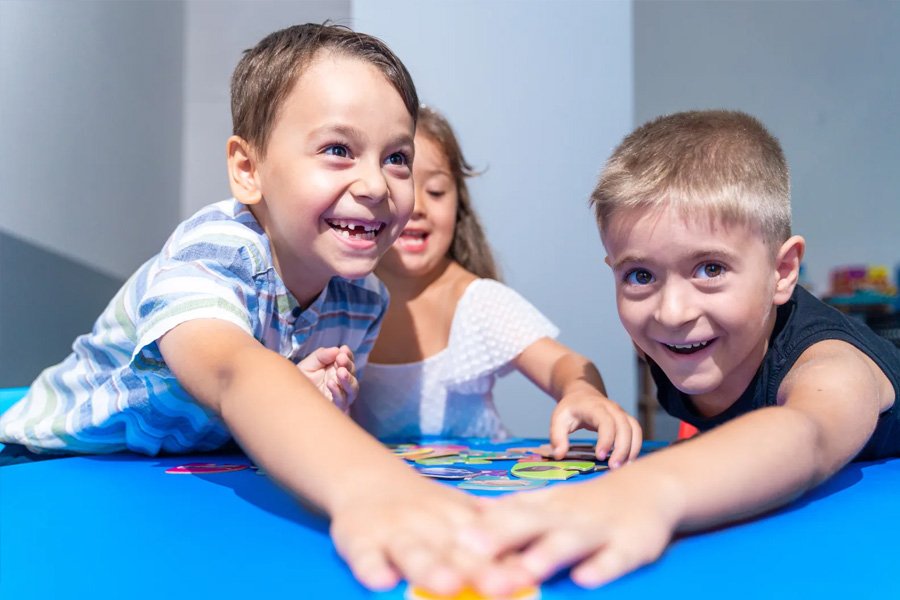
Social skills training for autism focuses on helping children build meaningful connections in ways that respect their communication styles and interests. Some children benefit from structured practice in social skills groups, while others prefer one-on-one coaching or supported play. Effective programs set individual goals rather than assuming every autistic child needs the same social behaviors. (Published social-skills study)
What Actually Gets Taught
What gets taught in social skills groups is more concrete than it sounds from the outside — reading a facial expression, taking a conversational turn, recognizing when a joke landed versus when it didn’t. These are specific, observable behaviors, which is exactly why they respond well to the same structured, data-driven teaching approach ABA uses for every other skill domain.
Why Parent and Teacher Involvement Matters
Research comparing different formats has found real value in including parents and teachers directly in the process, not just the child. One controlled comparison tracked children across three conditions — social skills training alone, social skills training with parent and teacher involvement, and standard care — using the Vineland Adaptive Behavior Scales and standardized social skills ratings to measure outcomes, reflecting a broader clinical consensus that social skills training autism programs taught only in a clinic setting generalize less reliably than skills reinforced consistently at home and school too.
“Structured social skills programs may support communication and peer interaction, but results vary across children and settings.”
It is a misconception that autistic children do not want friendship or connection. Social preferences vary widely, and some children seek company while others prefer smaller groups or different ways of communicating. Effective support begins by asking what the child enjoys and what kinds of interactions they want to develop. (Worldmetrics report)
A Common Misconception
Well-designed social skills groups tend to work well specifically because they provide low-stakes practice with actual peers, not just a clinician modeling a skill in isolation. A child can practice starting a conversation, handling a disagreement, or reading a group’s unspoken rules in a setting built for exactly that kind of rehearsal, with immediate, supportive feedback rather than the higher-stakes consequences of getting it wrong at school.
How social skills goals shift by age:
| Age Group | Typical Social Skills Focus |
| Toddlers | Shared attention, simple turn-taking during play |
| School-age | Conversation skills, friendship maintenance, group dynamics |
| Teens | Reading subtle social cues, navigating peer social complexity |
Group-Based Practice Works Differently
Age matters enormously for how social skills training autism programs should actually be structured. A toddler’s “social skills” goals look like shared attention and simple turn-taking during play; a school-age child’s goals shift toward conversation, friendship maintenance, and navigating group dynamics; a teenager’s goals often center on reading more subtle social cues and managing the higher-stakes social world of adolescence. A program built around a single curriculum for every age tends to underserve most of the children in it.
Age Changes the Goals
Measuring progress in social skills work requires more specific tracking than “seems more social lately.” A BCBA typically tracks concrete, observable targets — initiating a greeting independently, responding to a peer’s question, tolerating a change in a planned activity — the same data-driven discipline applied to every other ABA goal, which is what separates genuine skill-building from a well-meaning but unmeasured social group.
Generalization is the piece most programs underweight, and it’s the single biggest determinant of whether a skill taught in session actually shows up on the playground. A child who can identify a friend’s facial expression in a flashcard exercise but freezes when a real friend looks upset hasn’t yet generalized the skill — which is why the strongest programs build in practice across multiple real settings, not just the therapy room.
Rehearsal Tools That Actually Help
Role-play and video modeling are two of the more effective rehearsal tools used within structured social skills sessions, since both let a child practice a specific scenario repeatedly before encountering it for real. Watching a short video of a peer successfully joining a group activity, then practicing that same entry line in a low-pressure role-play with a therapist, gives a child a rehearsed, comfortable script to draw on instead of having to improvise an unfamiliar social moment from scratch under real social pressure.
Social connection isn’t a bonus outcome layered on top of “real” therapy goals — for most families, it’s one of the outcomes that matters most. A program that treats social skills with the same structured, measurable rigor as communication or behavior goals gives a child genuine, lasting tools for connection, rather than just a string of well-intentioned but ultimately unstructured, disconnected playdates.
Social skills groups should also make room for children who communicate differently or prefer quieter interactions. Success may look like sharing an interest with one peer, asking for space, or joining a game briefly. These goals are more meaningful when families and clinicians agree on what the child actually wants to practice.
Friendship Is a Skill, Not Just a Feeling
A friendship might begin with a shared interest, a familiar game, or a moment of genuine connection. Helping children discover their own ways to engage with others is what makes social development meaningful. Through individualized ABA therapy, Autism Pediatric Therapy & Learning Center supports developmental goals shaped around each child’s strengths. Start a conversation about the connections that matter most to your child.
This article is educational and general in nature. A qualified BCBA or clinical psychologist should assess a specific child’s social skills needs before designing or starting a program.