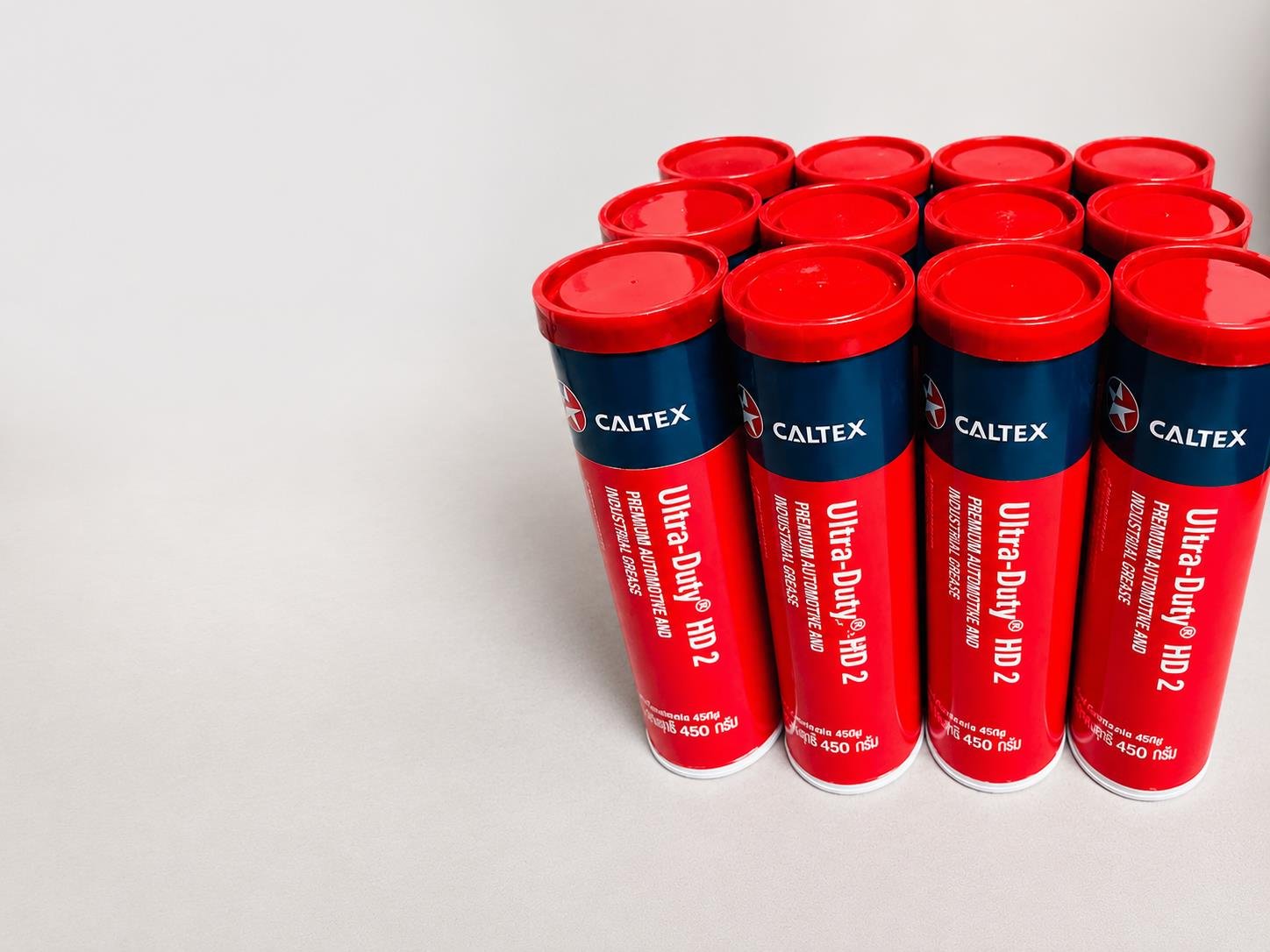
Three cartridges sit on the bench. One is red, one is blue, one is black. All three are marked EP2, all three fit the same grease gun, and the product data sheets do not make it obvious which one belongs in the wheel bearings, which one goes into the excavator pins, and which one is handling the rest of the fleet. For an operator servicing a mixed spread of tippers, prime movers, and earthmoving plant, that uncertainty has a real cost. Wrong grease in the wrong application contributes to premature bearing failures, wasted spend on premium product where a standard grade would do, and compatibility problems when a component has been running on one thickener type for years.
The difference between lithium, lithium complex, and moly grease comes down to what each one is built to handle. This article breaks down the three types in plain terms, covers where each one performs and where it falls short, and finishes with a practical product setup for a mixed fleet.
What Actually Makes a Grease
Grease is base oil held in place by a thickener, with additives blended in to handle specific operating conditions. The base oil does the actual lubricating. The thickener is the matrix that keeps it where it needs to be.
The thickener type is what separates lithium, lithium complex, and moly greases from one another. It determines how the grease behaves under heat, how well it resists water washout, and how long it holds together under mechanical stress.
NLGI grade describes consistency, not performance. Two greases both labelled EP2 can behave very differently under load depending on their thickener and additive package. Colour is a similar source of confusion. Red and blue greases often share the same thickener type, and black grease is black because of its moly content, not because of a different thickener. Reading the product label with an understanding of what thickener type and dropping point mean will generally tell an operator more than the colour of the cartridge ever will.
Standard Lithium Grease
Lithium soap-thickened grease has been the general-purpose standard across Australian workshops for decades. It performs reliably across a wide range of common applications and is available in most rural and regional supply outlets.
Its operating temperature range is suited to moderate conditions, generally up to around 120°C continuous. Above that threshold, the thickener begins to break down and the grease loses its ability to stay in place and protect bearing surfaces. In applications where heat builds and holds, this is a meaningful limitation.
Standard lithium grease is well suited to lower-stress points on the fleet. Tag trailer pivots, light-duty bushings, chassis grease points, and hand-greased fittings that see moderate load and moderate speed are all appropriate applications. It is generally not the right choice for wheel bearings on loaded tippers running highway distances, slewing rings on excavators, or any fitting where sustained heat or shock loading is part of normal operation.
Lithium Complex Grease
Lithium complex grease uses the same base chemistry as standard lithium but incorporates a complexing agent that raises the dropping point significantly, typically to 260°C and above. This makes it a more capable product in applications where heat is a consistent factor rather than an occasional one.
The practical benefits extend beyond temperature resistance. Lithium complex generally offers better resistance to shear breakdown under sustained mechanical stress, and stronger protection against water washout compared to standard lithium. For heavily loaded wheel bearings and hub assemblies running long highway stints, these properties matter.
Operators switching from standard lithium to lithium complex on existing components do not usually need to perform a full flush. Purging the old grease through the fitting before the new product takes over is considered best practice. Lithium complex is often the grease that resolves premature bearing failures on tipper hubs, particularly where the failure pattern points to heat-driven thickener breakdown rather than contamination or insufficient greasing intervals.
Moly Grease
Moly grease is a lithium or lithium complex base grease with molybdenum disulphide blended in, typically at a concentration of 3% or 5%. The moly particles are solid. Under pressure, they plate onto metal surfaces and form a dry-film layer that continues to protect the surface even when the oil film itself is squeezed out.
This makes moly grease well suited to sliding and oscillating contact under heavy load. Excavator pins and bushings, slewing rings, kingpins on prime movers, and fifth wheel plates are all applications where two surfaces move against each other under sustained pressure rather than rolling at speed. Standard grease films struggle in these conditions. Moly generally does not.
Moly grease is not appropriate for high-speed rolling element bearings. The solid particles can accumulate in a bearing running at speed and cause problems rather than prevent them. The choice between 3% and 5% moly content comes down to the severity of the application. Earthmoving pins and slewing rings under heavy shock load are typically better served by a 5% product. General heavy-duty sliding applications can usually run a 3% product without issue.
Matching Grease to Fleet
A mixed fleet of tippers, prime movers, tag trailers, an excavator, and a skid steer can usually be covered by two or three products. Getting the selection right and buying consistently in those products is more effective than buying whatever is available on a given week.
A three-product setup covers most situations. Lithium complex handles wheel bearings and hub assemblies on the tippers and prime movers. Moly grease at 3% or 5% covers excavator pins, slewing rings, kingpins, and fifth wheel plates. Standard lithium handles the lower-stress chassis points and tag trailer pivots where the elevated performance of the other two products is not required.
A two-product setup is also workable for operators who prefer to simplify further. Running lithium complex as the default across rolling and high-heat applications, and moly for all sliding and shock-load points, allows standard lithium to be dropped from the shed entirely. Once the product selection is settled, buying in pail or box quantities makes practical and economic sense. Mixed cartridge buying across multiple grades is often where confusion in the shed starts.
Conclusion
Lithium, lithium complex, and moly grease are not interchangeable, but they are not complicated once the job each one is built for is understood. Standard lithium suits lower-stress chassis points. Lithium complex handles heat and load in wheel bearings and hub assemblies. Moly covers the sliding and shock-load applications across excavator pins, kingpins, and fifth wheel plates.