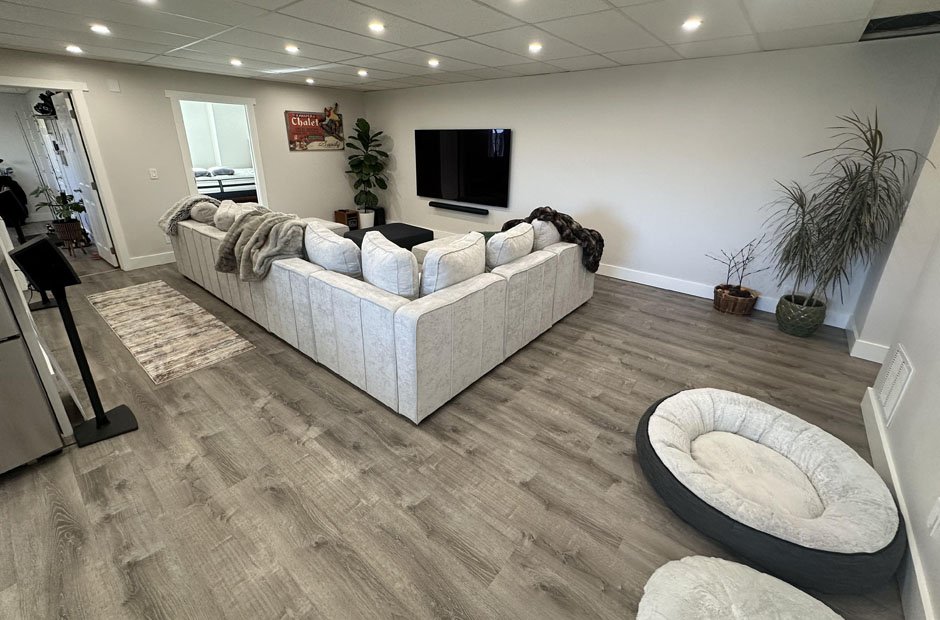
Most basements are genuinely underused. Not because they lack potential — but because nobody ever sat down and thought seriously about what they could be. A basement is essentially a blank slate: uninterrupted square footage that doesn’t need an addition, a permit for new construction, or a realtor to unlock. What it does need is intention.
Here’s how to take a cold, underused basement and turn it into a space your family actually wants to spend time in.
Start With the Foundation — Literally
Coziness is impossible in a damp space. Before you buy a single piece of furniture or pick a paint color, you need to know that your basement is genuinely dry — not just dry today, but protected from moisture year-round.
Humidity, seepage, and musty odors don’t respond to interior design. They respond to waterproofing. A basement that smells damp will never feel cozy no matter how many throw blankets you add. And finishing over an unresolved moisture problem means your investment in flooring, drywall, and furniture is at risk every time it rains heavily or the snow starts to melt.
Direct Waterproofing in Halton Hills offers free inspections and can tell you clearly whether your basement is ready to be transformed — or what needs to happen first to make it so. Getting this right before the renovation begins is what protects everything that comes after.
Warmth Starts With the Floor
Nothing kills the cozy feeling in a basement faster than cold, hard flooring underfoot. Concrete subfloors stay cool even in summer, and that coldness travels through whatever you put on top of it unless you address it properly.
The solution is a combination of the right flooring material and proper underlay. Luxury vinyl plank over a foam underlayment is one of the most effective choices — it’s warm underfoot, moisture-tolerant, durable, and looks far better than it has any right to at its price point. Engineered hardwood with a quality underlay is another strong option if you want the warmth of real wood.
Layer in area rugs over your finished floor and the difference is immediate. A large rug under a seating arrangement not only adds physical warmth — it visually defines the space, softens acoustics, and makes the room feel designed rather than functional.
Make the Ceiling Part of the Design
Low or unfinished ceilings are the most common thing people cite when they say their basement doesn’t feel livable. The good news is that both problems are solvable without necessarily drywalling the entire ceiling.
If height is limited, keep everything low — low-profile furniture, pendant lighting hung at the right height, shelving that draws the eye horizontally rather than vertically. Visual tricks matter: a ceiling painted the same color as the walls removes the hard contrast that makes low ceilings feel oppressive.
If you’re keeping the ceiling open and exposed — a popular choice that avoids the cost and complexity of drywalling — paint every element of it in a single matte dark color. Pipes, joists, ducts, everything. It makes the ceiling recede visually and gives the space an intentional, industrial-warm character that works surprisingly well in a cozy context.
Control the Light, Don’t Fight the Darkness
Trying to make a basement feel like a sun-filled room above grade is a losing battle. The more effective approach is to lean into the basement’s natural character — lower light, enclosed feel, sense of refuge — and make it work for you rather than against you.
This means warm-toned lighting (2700K bulbs, always), multiple light sources at different heights rather than a single overhead fixture, and thoughtful placement of lamps that create pools of light rather than flooding the entire room. Candles, fairy lights, and dimmer switches all contribute to an atmosphere that feels deliberately intimate rather than inadequately lit.
If you can add a window well or enlarge an existing window to bring in natural light, do it — it changes the entire character of the space. But if that’s not possible, warm artificial light handled well is genuinely enough.
Layer Texture to Create Warmth
Cozy is a tactile experience as much as a visual one. Basements with hard surfaces everywhere — concrete, painted drywall, tile — feel cold regardless of the temperature. Introducing texture through soft furnishings changes that perception immediately.
Think: a deep sectional with cushions you actually sink into, knit or woven throws draped over seating, curtains hung floor to ceiling even if there are no windows (they add softness and the illusion of height), and cushioned ottomans that double as flexible seating or a coffee table surface. These elements don’t need to be expensive — they need to be layered deliberately, because it’s the combination that creates the feeling, not any single piece.