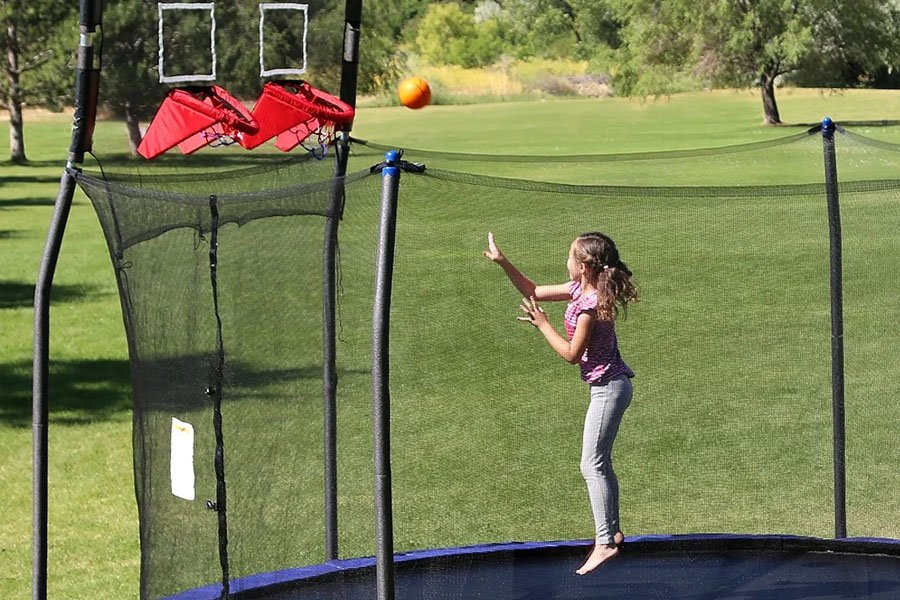
A trampoline already earns its keep as a backyard fixture, but pair it with a basketball hoop attachment and you’ve effectively turned one piece of equipment into two activities without adding a single square foot of yard space. For families working with a smaller backyard, or parents simply trying to get the most value out of one big-ticket purchase, a trampoline basketball hoop is one of the more practical upgrades available, and it’s worth understanding how it works before deciding if it’s right for your setup.
What a Trampoline Basketball Hoop Actually Is
These attachments mount directly onto the trampoline’s enclosure frame, positioning a basketball hoop and backboard above and to the side of the jumping surface. Unlike a freestanding driveway hoop, the setup is designed specifically around the mechanics of trampoline play: kids jump, shoot, and land, using the extra height a trampoline provides to dunk or shoot in ways a flat driveway simply doesn’t allow.
Products like the FlexrHoop, designed specifically for springless trampoline enclosures, typically run under $250 and attach without requiring a separate pole, footing, or concrete base, which is a meaningful difference from a standalone basketball hoop system. The trampoline’s existing frame and net structure do the structural work, so the hoop itself is a relatively simple add-on rather than its own installation project.
Why This Combination Works So Well
The appeal isn’t just convenience. Combining bouncing with shooting genuinely changes the nature of the activity in a few useful ways.
It adds a goal-oriented layer to unstructured play. Bouncing alone is fun, but it eventually plateaus into repetition. A hoop gives kids something to aim for, literally, which extends how long they stay engaged with the trampoline before boredom sets in.
It naturally scales difficulty. Younger kids can bounce gently and toss the ball underhand; older kids can attempt actual jump shots or dunks timed with the bounce. The same piece of equipment adapts across a wide age range without needing to be reconfigured.
It adds a genuine coordination challenge. Shooting a basketball while airborne on an unstable, moving surface requires timing, balance, and spatial awareness that a stationary hoop doesn’t demand. It’s a noticeably harder skill than driveway basketball, in a way kids tend to find engaging rather than frustrating, since the trampoline itself is still fun even on a missed shot.
It supports multiplayer play more naturally. A basketball hoop turns trampoline time into something with rules and turns, horse, one-on-one, simple point games, which encourages siblings and friends to play together rather than just take turns bouncing.
Installation: What to Actually Expect
Most trampoline basketball hoop attachments are designed for straightforward installation, typically clamping or bolting onto the existing enclosure poles or net rods rather than requiring new holes, footings, or separate mounting hardware. A few practical points are worth knowing before you buy one:
Check compatibility first. Hoop attachments are usually designed for a specific trampoline shape and enclosure type. A hoop built for a round trampoline enclosure won’t necessarily fit a square or oval frame, and springless enclosure systems (like those using flexible net rods) often require an attachment designed specifically for that structure rather than a rigid pole mount.
Positioning affects safety, not just gameplay. The hoop should be mounted high and clear enough that jumpers aren’t at risk of colliding with the backboard or rim mid-bounce. Most manufacturer instructions specify a minimum height and offset from the jumping surface for exactly this reason, and it’s worth following those specifications closely rather than eyeballing the placement.
Tools required are usually minimal. Most attachments are designed for a single adult to install in well under an hour, typically requiring nothing more than a wrench or basic hand tools, though it’s worth having a second person around to hold the hoop steady while you secure the mounting hardware.
Weather exposure matters for material choice. Since the hoop lives outdoors year-round alongside the trampoline itself, look for UV-resistant plastic components and rust-resistant mounting hardware, the same durability considerations that matter for the trampoline frame and mat also apply to the hoop and backboard.
Is It Worth Adding?
For most families already invested in a trampoline, a basketball hoop attachment is a low-cost, low-effort way to meaningfully extend how much use the trampoline gets. It doesn’t require additional yard space, doesn’t need its own foundation, and turns a single piece of equipment into a more varied, more social activity. Given how directly it supports the same goals that make a trampoline worthwhile in the first place, active play, extended outdoor time, and reduced reliance on screens for entertainment, it’s one of the more straightforward upgrades to justify.