
Core Pillars of Phoenix Retirement and Estate Planning
As we approach October 2026, many of us are thinking about retirement. For those living or working in the Phoenix area, this next chapter requires careful planning. We understand that securing your financial future is a top priority.
Imagine a calm Arizona desert landscape, a fitting place to plan your wealth. While Tucson is known for its wealth and retirement planning benefits, understanding Phoenix retirement and estate planning is vital for local residents.
This guide aims to make your journey clearer. We will explore the special retirement plans available to City of Phoenix employees. This includes understanding pension systems, maximizing contributions, and using health benefits.
We will also cover important estate preservation tips. You will learn about probate avoidance and protecting your property. An infographic will help explain Arizona’s retirement systems and timelines for preserving your wealth.
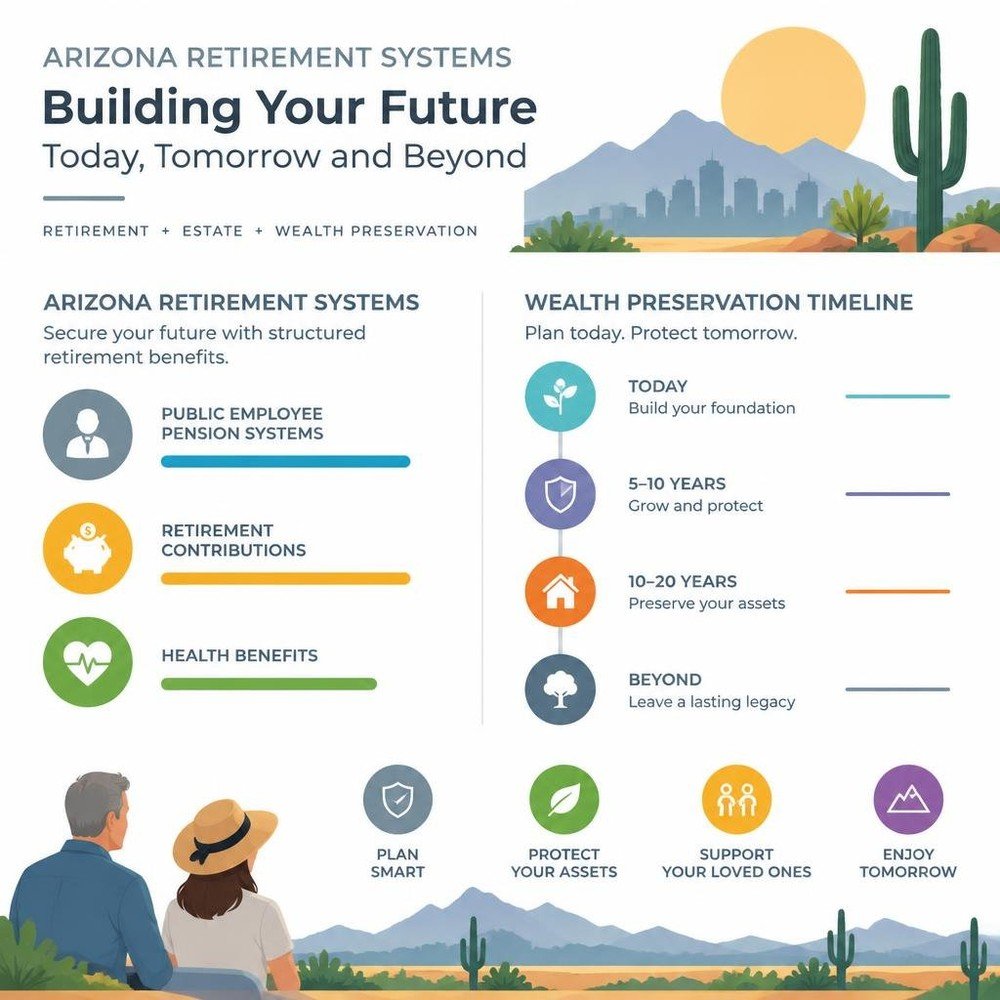
Navigating the complexities of retirement planning as a City of Phoenix employee means understanding a unique set of benefits and regulations. Our goal is to empower you with the knowledge to make informed decisions about your financial future, ensuring a smooth transition into retirement. This section delves into the specific plans and strategies available to you.
To provide a clear overview, here’s a comparison of the primary retirement structures for City of Phoenix employees:
| Feature | COPERS (City of Phoenix Employees’ Retirement System) | PSPRS (Public Safety Personnel Retirement System) | 457(b) Deferred Compensation Plan (Traditional/Roth) | 401(a) Defined Contribution Plan (Special Pay) |
|---|---|---|---|---|
| Who it’s for | Most City of Phoenix general employees | Sworn public safety personnel (Police, Fire) | All City of Phoenix employees | All City of Phoenix employees |
| Type | Defined Benefit Pension Plan | Defined Benefit Pension Plan | Deferred Compensation (Employee Contributions) | Defined Contribution (Employer/Sick Leave Payouts) |
| Contributions | Employer & Employee (pre-tax) | Employer & Employee (pre-tax) | Employee elective deferrals | Mandatory sick leave payouts (pre-tax) |
| Tax Treatment | Pre-tax contributions, taxed at withdrawal | Pre-tax contributions, taxed at withdrawal | Traditional: Pre-tax, taxed at withdrawal; Roth: Post-tax, tax-free withdrawals | Pre-tax, taxed at withdrawal |
| Key Feature | Lifetime income, eligibility based on age/service | Lifetime income for public safety | Penalty-free withdrawals upon separation (public sector advantage) | Maximize sick leave payout deferrals |
Municipal Pension Structures: COPERS vs PSPRS
For most City of Phoenix employees, the primary pension plan is the City of Phoenix Employees’ Retirement System (COPERS). This is a defined benefit plan designed to provide a steady income stream throughout your retirement. Eligibility for retiring under COPERS is typically determined by a combination of age and years of service.
The most common pathways to retirement eligibility include:
- Rule of 80/87: This rule allows employees to retire when their age plus years of service equals 80 (for certain categories) or 87 (for others). If you qualify under the Rule of 80 or 87, you must file your Application for Retirement 14 calendar days prior to your intended retirement date.
- Age-based Requirements: Alternatively, you can retire at age 60 with 10 years of service, or at age 62 with 5 years of service. For these age-based criteria, a 30-calendar-day notice period for your Application for Retirement is required.
It’s crucial to adhere to these timing rules to ensure your benefits are processed without delay. For personalized information and to keep your contact details updated, the eCHRIS portal serves as a valuable resource.
Sworn public safety personnel in Phoenix, such as police officers and firefighters, are covered under a different system: the State of Arizona’s Public Safety Personnel Retirement System (PSPRS). PSPRS is a statewide system tailored to the unique demands and risks associated with public safety careers, operating independently of COPERS.
Maximizing Contributions in Phoenix Retirement and Estate Planning
Beyond your primary pension, the City of Phoenix offers several supplemental plans to enhance your retirement savings, each with distinct advantages. These include the 457(b) Deferred Compensation Plan (available in both Traditional and Roth versions) and the 401(a) Defined Contribution Plan.
The 457(b) Traditional plan allows you to contribute pre-tax dollars, reducing your current taxable income. Your earnings grow tax-deferred, and withdrawals in retirement are taxed as ordinary income. A significant advantage of the 457(b) for public sector employees is the ability to make penalty-free withdrawals upon separation from service, regardless of age, which differs from private sector 401(k) plans.
The Roth 457(b) plan, conversely, involves after-tax contributions. This means your contributions don’t reduce your current taxable income, but qualified withdrawals in retirement are entirely tax-free. This option can be particularly appealing to younger employees who anticipate being in a higher tax bracket during retirement. To qualify for tax-free withdrawals, the account must be open for at least five years, and you must be age 59½ or older, disabled, or deceased.
The 401(a) Defined Contribution Plan includes a crucial component known as “Special Pay.” This is where the ‘circular calculation’ for sick leave payouts comes into play. When you retire, your accumulated eligible sick leave payout can be contributed on a pre-tax basis into your 401(a) Special Pay account, up to the annual IRS maximum. Any amount exceeding this 401(a) limit is then automatically directed to your 457(b) plan. This “circular calculation” allows retiring employees to maximize the deferral of their sick leave payout, converting what would otherwise be a taxable lump sum into tax-advantaged retirement savings. A key benefit of the 401(a) Special Pay component is that these contributions are exempt from FICA (Social Security and Medicare) taxes, offering an additional layer of tax savings.
To fully leverage these plans, especially the sick leave payout deferrals, employees should:
- Understand IRS Limits: Be aware of the annual contribution limits for both 401(a) and 457(b) plans, as these can change annually.
- Plan Ahead: Coordinate with the City’s retirement office to ensure your sick leave payout is correctly allocated and maximized through the circular calculation.
- Consider Roth: Evaluate if the Roth 457(b) aligns with your long-term tax strategy, especially if you expect higher taxes in retirement.
Health Reimbursement and PEHP Benefits
Beyond pension and deferred compensation, the City of Phoenix also provides a valuable Post Employment Health Plan (PEHP) to help cover medical expenses in retirement. The PEHP is an employer-funded health reimbursement arrangement (HRA) designed to assist eligible employees with healthcare costs after they separate or retire from City service.
Here’s how it works:
- Employer-Funded Contributions: The City of Phoenix contributes $150 per month to an eligible employee’s PEHP account, starting the month after hire. These contributions accumulate over your career.
- No Employee Contributions: Unlike other retirement plans, employees cannot make their own contributions to the PEHP. It is solely funded by the employer, making it a “free money” benefit.
- Qualified Medical Expenses: After separation or retirement, the accumulated funds in your PEHP account can be used to reimburse a wide range of qualified medical expenses. This includes health insurance premiums (for yourself and eligible dependents), deductibles, co-pays, prescription drugs, and other out-of-pocket medical costs that are not covered by other insurance.
- Tax-Free Reimbursements: Reimbursements from your PEHP for qualified medical expenses are tax-free, providing a significant financial advantage in managing healthcare costs during retirement.
The PEHP is a critical component of Phoenix retirement planning, offering a dedicated fund for healthcare expenses, which often become a major concern for retirees. It’s administered to ensure that funds are used for legitimate medical costs, providing peace of mind for your post-employment healthcare needs.
Navigating Arizona Estate Preservation and Property Risks
As you transition into retirement, focusing on estate preservation becomes paramount. Protecting your assets, especially real property, from potential risks and ensuring a smooth transfer to your beneficiaries is a vital aspect of comprehensive Phoenix retirement and estate planning.
Probate Avoidance and Phoenix Retirement and Estate Planning Assets
Probate is the legal process of proving a will and distributing a deceased person’s assets. In Arizona, this process can be time-consuming, public, and expensive. Fortunately, many assets can be structured to bypass probate entirely, ensuring a quicker and more private transfer to your heirs.
Assets that typically skip probate in Arizona include:
- Trust Assets: Property held within a living trust (revocable or irrevocable) avoids probate because the trust, not the individual, owns the assets. The successor trustee can distribute assets according to the trust’s terms.
- Jointly Held Property with Right of Survivorship: Assets like real estate, bank accounts, or brokerage accounts held as “joint tenants with right of survivorship” automatically pass to the surviving owner(s) upon the death of one owner.
- Beneficiary Deeds: For real estate in Arizona, a beneficiary deed allows you to name a beneficiary who will automatically receive the property upon your death, without going through probate.
- Payable-on-Death (POD) Accounts: Bank accounts can be designated as POD, meaning the funds automatically transfer to the named beneficiary upon your death.
- Transfer-on-Death (TOD) Registrations: Similar to POD, TOD registrations apply to investment accounts, stocks, and bonds, allowing them to pass directly to beneficiaries.
- Life Insurance Policies: The proceeds of life insurance policies are paid directly to the named beneficiaries and do not go through probate.
- Retirement Accounts: 401(k)s, 403(b)s, IRAs, and the City of Phoenix’s 457(b) and 401(a) plans all allow you to name beneficiaries. Upon your death, these assets are typically distributed directly to those beneficiaries, bypassing probate.
Conversely, any assets titled solely in your name without a beneficiary designation or held within a trust will likely need to go through the probate process. Proactive planning with beneficiary designations and trusts is key to streamlining your estate and protecting your legacy.
Here is a list of common Arizona non-probate wealth assets:
- Assets held in a Revocable Living Trust
- Real Estate with a Beneficiary Deed
- Bank Accounts with a Payable-on-Death (POD) designation
- Investment Accounts with a Transfer-on-Death (TOD) registration
- Life Insurance Policies with named beneficiaries
- Retirement Accounts (IRAs, 401(k)s, 457(b)s, etc.) with named beneficiaries
- Property held as Joint Tenants with Right of Survivorship
Protecting Real Property Under Arizona Adverse Possession Laws
While planning for the distribution of your assets, it’s equally important to protect them during your lifetime. Real property, a significant asset for many Phoenix retirees, faces a unique risk under Arizona’s adverse possession laws.
Under Arizona law (A.R.S. § 12-526), if someone is in “peaceable and adverse possession” of your land and cultivates, uses, or enjoys it for a continuous period of ten years, they can potentially bar the true owner from recovering that land. This means that if a neighbor, for example, quietly fences off and uses a portion of your property for a decade without challenge, they could eventually claim legal ownership of that section.
This statute has significant implications for estates and trusts holding real property, especially if the property is not regularly monitored or if heirs are not immediately aware of its boundaries and use. The “peaceable possession” aspect means the possessor’s use must be open, notorious, and not involve force. “Adverse possession” means it must be without the true owner’s permission and hostile to their ownership claim.
Key considerations for Phoenix retirees and their families:
- Timeliness is Crucial: If an estate inherits real property, inspect it promptly. Any long-standing boundary disputes or unauthorized uses must be addressed within the ten-year window.
- 160-Acre Limit: Without a recorded memorandum defining the boundaries, the statute caps adverse possession claims at 160 acres.
- Disability Tolling: The ten-year period can be extended (tolled) for minors or individuals with legal disabilities, adding another layer of complexity.
To safeguard your real property:
- Maintain Clear Records: Ensure all property deeds, surveys, and boundary descriptions are accurate and up-to-date.
- Regular Inspections: Periodically inspect your property, especially if it’s vacant or infrequently visited, to identify any signs of encroachment or unauthorized use.
- Address Issues Promptly: If you discover any adverse use of your land, consult with an Arizona real estate attorney immediately to understand your options and take action to protect your title.
Ignoring these risks can lead to the loss of valuable real estate, impacting your estate and the legacy you intend to leave. Proactive management and vigilance are your best defenses against adverse possession claims.