Key Takeaways
- Removing walls changes acoustics, airflow, and odor circulation. Plan for all three.
- Appliance placement becomes a design decision, not just a practical one, in an open Alpharetta home
- Zoning with furniture, lighting, and materials keeps open spaces from feeling chaotic
- Structural walls in Alpharetta’s newer builds still require professional assessment before any demolition
- Kitchen visibility in open layouts means appliance condition and appearance both matter
- Open floor plans have become a standard buyer expectation across Alpharetta’s most desirable neighborhoods
I used to think an open floor plan was the obvious upgrade for any Alpharetta home. Tear down a wall, flood the space with light, and suddenly the house feels twice as big. That was the dream, anyway.
What nobody told me was how much an open layout changes the way you actually live.
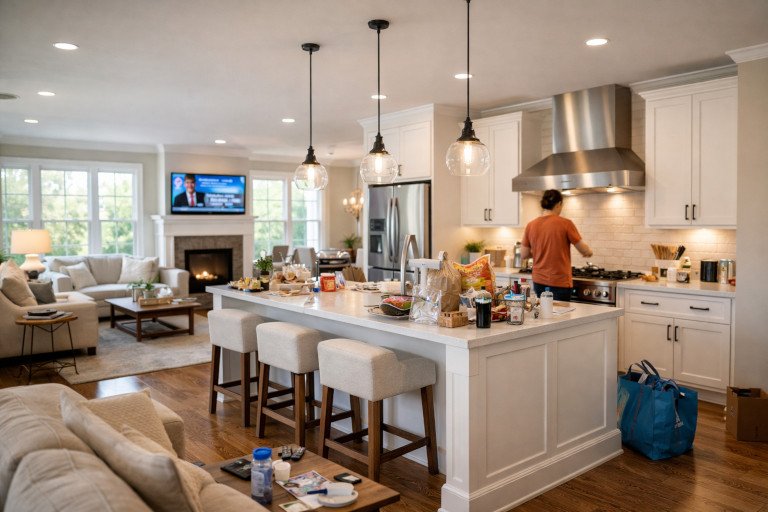
Cooking smells travel farther than you expect. Television noise bleeds straight into the kitchen. And suddenly your refrigerator is basically living room furniture.
This article is for Alpharetta homeowners considering an open-floor-plan renovation, or those who already have one and are trying to make it work. I’ll walk through what I’ve seen go right, what goes wrong, and how to design for the reality of daily life in North Fulton County—not just the listing photos.
What an Open Floor Plan Actually Changes in an Alpharetta Home
It’s Not Just About Space — It’s About Sound
The first thing I noticed after opening up my kitchen to the living area was the noise. Dishwashers, range hoods, and blenders (sounds that used to stay behind a wall) now compete with conversation and television.
Hard flooring, which many Alpharetta open-plan homes favor, makes this worse. Without walls to absorb sound, noise bounces. If you’re designing from scratch, budget for acoustic insulation in the ceiling above the kitchen zone, and consider a range hood with a low sone rating.
Smells Travel Farther Than You Think
An open kitchen means your whole living space smells like whatever you’re cooking. On a Sunday when you’re slow-roasting something, that’s great. On a Wednesday night when you’re reheating fish, it’s less ideal.
A high-quality range hood with the right CFM (cubic feet per minute) capacity for your cooking style is essential in an open Alpharetta kitchen. I’d also recommend keeping ventilation pathways clear. It’s something I overlooked until a professional pointed it out during a routine inspection.
Zoning: How Alpharetta Homeowners Create Definition Without Walls
Use the Floor to Tell the Story
One of the most effective ways to define zones in an open Alpharetta home is through flooring transitions. A kitchen area in tile or contrasting hardwood, shifting to a warmer wood tone in the living zone, creates separation without adding walls.
This also works in practice. It signals where the kitchen ends without needing a wall. Many of the newer builds in Alpharetta’s communities, such as Windward, Avalon-area neighborhoods, and the Webb Bridge Road corridors, already use this approach as a design standard.
Lighting Zones Are Just as Important as Fixtures
Most homeowners design open-floor-plan lighting as one broad plan. That’s a mistake. Each zone needs its own lighting logic.
The kitchen needs task lighting, such as under-cabinet strips and pendant lights over an island. The dining area benefits from a statement fixture on a dimmer. The living zone needs layered ambient and accent lighting. When each zone has its own lighting logic, the open space feels intentional rather than unfinished.
This matters especially in Alpharetta homes with large windows. The natural light shifts dramatically from morning to evening, and your artificial lighting plan needs to compensate.
Furniture as Architecture
A well-placed sofa facing away from the kitchen, a large area rug anchoring the living zone, or a kitchen island doubling as a visual boundary. Furniture often ends up doing the work that walls used to do. In my experience, the kitchen island becomes the most valuable design element in an open-plan Alpharetta kitchen. It defines the cooking space, adds storage, and creates a natural gathering point in the room.
If you’re rethinking your cabinet layout as part of the renovation, it’s worth exploring sustainable kitchen cabinet design trends that complement open-plan aesthetics.
Once the layout is open, the next challenge becomes visibility, especially in the kitchen.
Appliance Placement in an Alpharetta Open Floor Plan
Appliance placement is where many Alpharetta open-floor renovations fall short.
In a closed kitchen, your appliances are tucked behind a door. In an open layout, your refrigerator, range, and dishwasher are visible from the couch. That changes the design calculus entirely.
Appliances Are Now Part of Your Décor
Panel-ready refrigerators and dishwashers (designed to accept cabinet fronts) are increasingly popular in Alpharetta’s higher-end open-plan homes precisely because of this visibility. If panel-ready is outside your budget, at a minimum, choose finishes that complement your overall palette. A stainless steel refrigerator against warm wood cabinetry can look sharp. The same fridge with a dented door panel is the first thing every guest sees.
Maintenance Matters More When Everything Is on Display
An appliance that vibrates, runs loudly, or performs inefficiently is easy to ignore when it’s tucked behind a closed kitchen door. In an open layout, it becomes everyone’s problem. Once you open up your floor plan, you’ll naturally become more proactive about appliance upkeep. I always tell homeowners to have a trusted technician on speed dial, and Appliance EMT is a great choice for appliance repair in Alpharetta. It’s exactly the kind of resource worth having before something goes wrong.
Where to Position the Refrigerator
Ideally, the refrigerator sits on the perimeter of the kitchen zone and does not protrude into the main traffic flow. It should be accessible without requiring someone to walk through the cooking area, especially in active Alpharetta households where people move through the kitchen throughout the day.
Open Floor Plans Across Alpharetta’s Neighborhoods
In Alpharetta, open floor plans are no longer just a trend. They’re the standard in new construction and heavily renovated resale homes.
Communities along the GA-400 corridor are largely designed around open-concept living. This includes master-planned neighborhoods near Windward Parkway and newer developments near Halcyon in neighboring Forsyth County. Buyers in these markets have come to expect connected kitchen, dining, and living spaces as a baseline feature.
Alpharetta’s older neighborhoods, particularly those built in the late 1980s and 1990s near Old Milton Parkway and Kimball Bridge Road, are where the renovation opportunity is most active. Homeowners in these areas are increasingly opening up compartmentalized floor plans to compete with newer inventory and to modernize homes that were built before open layouts became standard.
The Georgia climate adds another important layer of consideration. Alpharetta summers are hot and humid, and an open floor plan requires your HVAC system to efficiently condition a larger, undivided space. Proper HVAC sizing, sealed ductwork, and regular maintenance become more important in an open layout—something worth accounting for in your renovation budget.
Alt text: Open floor plan kitchen and living room in an Alpharetta home showing cluttered island and visible appliances from the living area
What Alpharetta Homeowners Get Wrong About Open Floor Plans
The biggest mistake I see Alpharetta homeowners make is treating the open floor plan decision as purely aesthetic. They want the look, they demo the wall, and then spend years solving problems that could have been anticipated.
Here’s what I’d tell anyone in Alpharetta considering this renovation:
Talk to a structural engineer before getting too far into design ideas. Not every wall can come down. Alpharetta’s newer builds often use engineered lumber and steel beam systems that aren’t always obvious to the naked eye. Load-bearing walls require beams, posts, and permits from Fulton County or the City of Alpharetta, depending on your location. The structural work often costs more than people budget for.
Think carefully about where you’ll hide everyday clutter. Open kitchens mean open counters. If you’re not someone who naturally keeps surfaces clear, an open layout will stress you out. Plan for more closed storage than you think you need. This is especially relevant in Alpharetta homes, where the kitchen island becomes the default drop zone for everything.
Factor in resale value, but design for daily life first. Alpharetta’s real estate market strongly favors open floor plans. But the homes that hold their value and genuinely function well are always the ones where someone thought through acoustics, zoning, lighting, and appliance placement — not just square footage.
Frequently Asked Questions
Do Alpharetta homes typically need permits to remove a wall?
Yes. Whether your home falls under City of Alpharetta or Fulton County jurisdiction, structural changes typically require a building permit. A licensed contractor familiar with local codes can walk you through the process and ensure the work is properly inspected.
Which Alpharetta neighborhoods have the most potential for open-floor-plan renovations?
Older subdivisions built in the late 1980s and 1990s, particularly around Old Milton Parkway, Kimball Bridge Road, and the Wills Road corridor, tend to have the most compartmentalized layouts and the greatest opportunity for open-plan renovation. These homes also typically have strong resale upside after the work is done.
Does an open floor plan increase home value in Alpharetta?
In most cases, yes. Alpharetta buyers consistently prioritize open, connected living spaces. A well-executed open-floor-plan renovation can meaningfully improve both marketability and sale price, particularly for older inventory competing with newer construction.
How do I manage cooling costs in an open Alpharetta home?
Georgia summers put real demand on HVAC systems in open-plan homes. Make sure your system is correctly sized for the combined square footage of your open space, have ductwork inspected for leaks, and consider a smart thermostat to manage zoned cooling across different areas of the home.
What’s the best way to define kitchen and living zones in an Alpharetta open floor plan?
A combination of flooring transitions, distinct lighting plans, area rugs, and a well-positioned kitchen island works best. Many Alpharetta interior designers also use ceiling treatments, such as coffered ceilings or beams, to define zones overhead without adding walls.
Final Thoughts on Open Floor Plans
An open floor plan can transform how an Alpharetta home feels and functions, and in this market, it often makes strong financial sense as well. But the transformation only works when the design accounts for how you actually live: the noise, the smells, the visible appliances, the traffic patterns, and the daily reality of a busy household.
I’ve seen it done beautifully in homes across Alpharetta, and I’ve seen it create more problems than it solved. The difference is almost always in the planning before the walls come down, not after.
Plan carefully and design intentionally, and an open floor plan can become one of the most valuable upgrades you make to an Alpharetta home.