Key Takeaways
- Data-driven consulting enhances decision accuracy and operational efficiency.
- Advanced analytics provide real-time insights, enabling proactive adjustments to strategy.
- Integrating AI and machine learning revolutionizes traditional consulting approaches.
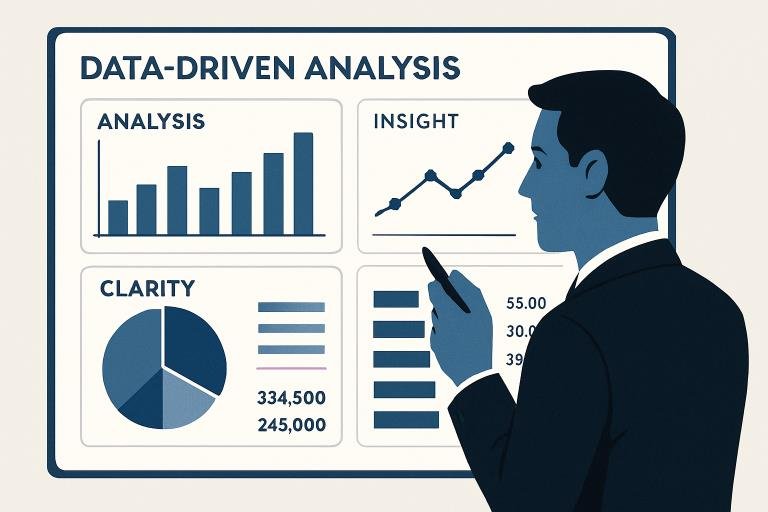
In today’s competitive and fast-paced business environment, organizations face increasing pressure to make informed strategic choices based on factual analysis rather than intuition or outdated models. By leveraging Stratford Analytics economic impact analysis, companies can now harness cutting-edge data-driven economic consulting methodologies to bring unprecedented clarity to critical decisions. This data-led transformation equips decision-makers with real-time, actionable insights and sophisticated economic frameworks to navigate change and uncertainty.
Unlike the legacy approach of relying on intuition or anecdotal benchmarks, modern economic consultants integrate advanced analytics, economic modeling, and artificial intelligence to identify trends, anticipate risks, and optimize strategies at scale. The combination of digital tools and economic expertise helps firms zero in on value creation opportunities, mitigate downside risks, and foster innovation—maximizing both resilience and profitability.
Successful organizations view data-driven consulting as an enabler for agility and more intelligent choices, turning complex, multifaceted data streams into coherent stories and clear scenarios for action. This approach fundamentally reshapes organizational decision-making and sets leaders apart in fast-evolving industries.
As the volume and velocity of market data increase, leading C-suites recognize the need for expert guidance to unlock the full value of advanced analytics. Economic consulting firms now play a pivotal role in providing external objectivity and rigorous methodologies tailored to the new digital era.
The Shift Towards Data-Driven Consulting
Traditional management consulting revolved around experience-based recommendations, interviews, and qualitative assessments. However, today’s market dynamics are too volatile and granular to be steered by intuition alone. The widespread adoption of big data analytics marks a transformative shift: by systematically collecting and analyzing internal and external datasets, consultants now uncover nuanced patterns, reveal inefficiencies, and identify growth opportunities far earlier than previously possible.
Industry reports from sources such as Harvard Business Review emphasize that data-driven decision-making correlates strongly with market leadership and higher profitability. By going beyond historic trend lines and embracing predictive analytics, companies can dramatically improve their responsiveness to rapidly changing customer preferences and market shifts.
Enhancing Decision Accuracy with Advanced Analytics
The introduction of advanced analytics and AI-powered platforms into consulting workflows enables the exposure of previously hidden trends. For example, machine learning models can continuously process sales data, customer sentiment, and sector-wide signals to forecast future demand or pinpoint resource misallocations before they snowball. Leading organizations report a 20% increase in decision accuracy and significant reductions in wasted resources by integrating these dynamic models into their strategic planning processes.
Furthermore, companies that rapidly adapt data-driven approaches are outperforming laggards in operational metrics, innovation speed, and market share. Sectors ranging from finance to retail are utilizing analytics-driven economic consulting to develop new business models and streamline decision-making processes.
Real-Time Insights for Proactive Strategies
Market conditions often shift overnight, making real-time intelligence essential for maintaining competitiveness. Data-driven economic consulting provides near-instantaneous scenario modeling and risk analysis, equipping managers with the situational awareness necessary to capitalize on emerging opportunities or mitigate sudden threats. Timely access to up-to-date insights allows companies not only to react but to anticipate—and confidently capitalize on—market movements.
Integrating AI and Machine Learning
The integration of AI and machine learning represents a seismic leap for strategic consulting. Automation eliminates much manual data processing, speeds analysis, and uncovers correlations that even skilled human analysts might overlook. AI tools can synthesize vast datasets and recommend optimal paths forward, while machine learning models continually evolve to improve the accuracy of forecasts over time.
For consultancies, these technologies enable deeper client engagement through interactive dashboards, predictive models, and even the generation of custom recommendations tuned to specific business objectives. This technological convergence is shifting economic consulting from a retrospective to a truly forward-looking approach.
Case Study: AI in Strategic Decision-Making
Recent academic research demonstrates the power of AI in high-stakes strategic contexts. One study found that contemporary Large Language Models (LLMs) can rival human experts, including entrepreneurs and investors, in generating, evaluating, and refining strategic business plans. AI’s ability to process vast quantities of market intelligence, evaluate numerous possible strategies, and simulate competitor reactions offers scale, speed, and objectivity far beyond those of human consulting teams. For a deeper exploration, see the research summary by Nature.
Challenges and Considerations
The ascent of data-driven consulting comes without hurdles. Key concerns include safeguarding sensitive data, maintaining robust cybersecurity protocols, and assembling teams with the right mix of data science, economics, and industry expertise. There is also the risk of over-reliance on quantitative data, sometimes at the expense of qualitative context or stakeholder input. Organizations must ensure that both statistical rigor and human judgment guide their most important decisions.
Conclusion
Adopting data-driven economic consulting empowers enterprises to set more resilient, responsive, and innovative strategies. By combining financial expertise with advanced digital tools, leading firms position themselves to thrive amid the complexity and disruption that define modern markets. The future belongs to those who adapt quickly—and the time to invest in data-driven decision-making is now.