
Core Methodologies in Aerospace and Defense Testing
In the high-stakes world of aerospace and defense, the ability of a platform to perform under extreme conditions is not just a technical requirement but a fundamental mission necessity. We define Strategic Reliability as the deliberate, data-driven methodology used to ensure that critical systems remain operational throughout their entire lifecycle, effectively mitigating the risks of unexpected failure.
By shifting our focus from reactive maintenance to proactive risk management, we protect assets that operate in the most demanding environments on Earth and beyond. Integrating these high-level principles into our advanced testing services allows us to bridge the gap between design intent and field performance, ensuring that every component meets the rigorous standards required for mission success.
A successful reliability program also depends on disciplined configuration control and traceability. Test articles must accurately represent production hardware, including materials, firmware versions, fasteners, coatings, connectors, and manufacturing processes. When deviations occur, engineering teams need clear records showing whether a test result reflects the intended design or a temporary prototype condition. This documentation rigor strengthens qualification evidence, supports root-cause investigations, and gives program stakeholders confidence that laboratory findings can be translated into dependable field performance.
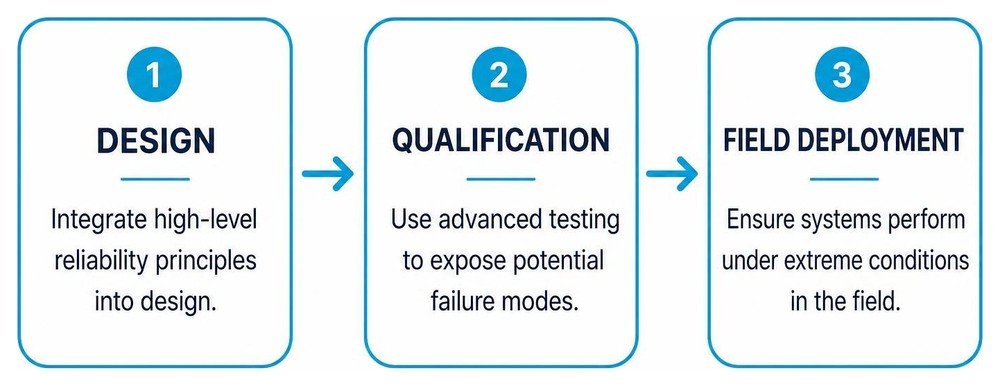
Reliability is not a static quality; it is an engineered outcome. To achieve it, we utilize a combination of environmental, mechanical, and electromagnetic testing. These protocols are designed to expose potential failure modes before they manifest in the field, ensuring that our systems are resilient against the harsh realities of their operational environments. Through rigorous empirical validation, engineering teams can identify subtle design vulnerabilities, material flaws, and assembly defects early in the development cycle, significantly reducing costly engineering changes down the line.
Modern defense systems operate across sea, land, air, space, and cyberspace domains. Each domain introduces unique physical and environmental stresses, ranging from hyper-velocity aerodynamic drag and cryogenic space temperatures to intense acoustic pressures generated during rocket launches. A comprehensive test campaign does not merely aim to achieve compliance with minimal thresholds; it rigorously explores operational margins, boundary conditions, and cumulative fatigue limits to establish true mission resilience.
Environmental and Structural Testing Methodologies
Our approach to structural integrity relies on rigorous simulation and dynamic environmental screening. We subject components to multi-axis vibration, thermal vacuum cycles, high-G mechanical shocks, and acoustic stress to mirror the fatigue-inducing conditions of flight, launch profiles, and rapid tactical deployment. Structural stress screening combines electrodynamic shakers, acoustic reverberation chambers, and centrifuge acceleration rigs to recreate combined-stress operational environments that legacy single-axis tests fail to expose.
By employing Monte Carlo simulations and advanced finite element models, we can model the probability of failure across a wide range of operational and environmental variables. These probabilistic models factor in manufacturing tolerances, microstructural material variance, temperature fluctuations, and cyclic loading spectrums. This analytical depth allows us to predict the service life of a component with high statistical confidence. Proactive structural reliability is essential for extending the operational life of assets without compromising human safety, flight safety, or mission assurance.
Thermal vacuum (TVAC) testing is particularly crucial for spaceflight systems and high-altitude payloads. In low-pressure or zero-pressure conditions, heat dissipation cannot rely on atmospheric convection. Hardware must withstand extreme radiant thermal gradients, where one side of a platform faces the intense heat of solar radiation while the other experiences deep-space cold soaking. Controlled thermal cycling within specialized vacuum chambers ensures that composite bonded joints, semiconductor interfaces, and structural substrates maintain their geometric and structural integrity through repeated orbital transitions.
Implementing Failure Mode and Effects Analysis in Aerospace and Defense Testing
Failure Mode and Effects Analysis (FMEA) and Failure Mode, Effects, and Criticality Analysis (FMECA) serve as the backbone of our risk mitigation strategy. By systematically mapping out every potential failure point, root-cause mechanism, and assigning a quantitative criticality score, we can prioritize testing efforts where they are most urgently needed. This structured approach prevents blind spots in complex multi-layered assemblies where secondary failure propagation could lead to catastrophic system degradation.
We place special emphasis on the Potential Failure to Functional Failure (P-F) interval, identifying the earliest possible symptoms of mechanical wear, thermal fatigue, or electrical degradation. Detecting these nascent warning indicators through high-resolution sensor arrays, acoustic emission monitors, and non-destructive evaluation (NDE) enables engineering teams to implement preventive measures and design reinforcements that eliminate defects before they result in mission-critical downtime or system loss in theater.
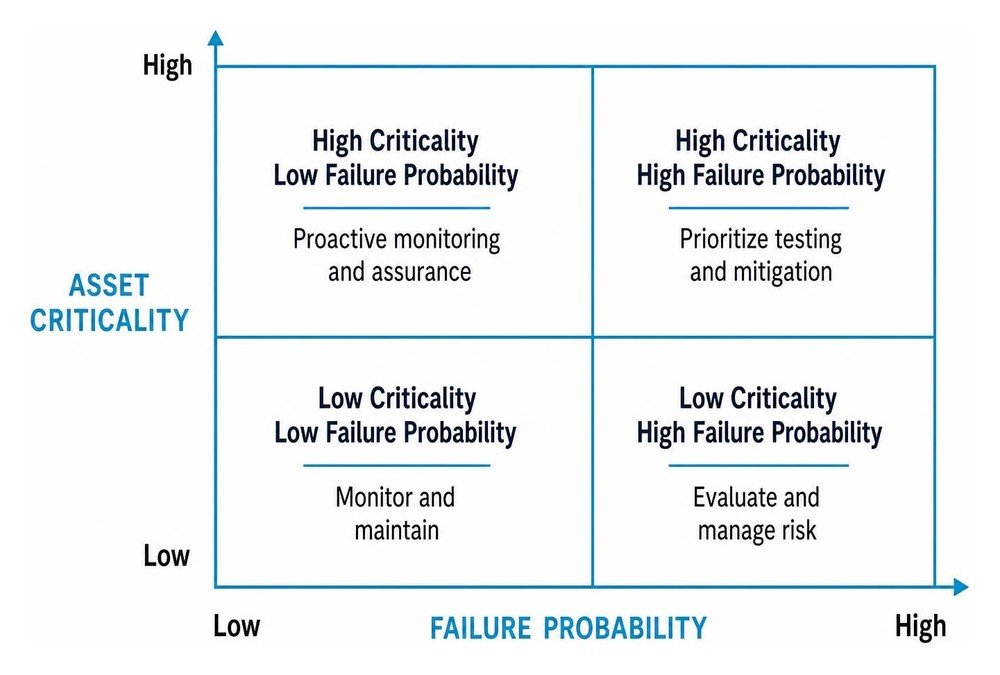
Furthermore, integrating Physics of Failure (PoF) concepts into the FMEA framework empowers engineers to analyze how specific stress mechanisms—such as solder joint creep, intermetallic compound growth, dielectric breakdown, and corrosion kinetics—behave over time under operational profiles. Coupling physical degradation physics with empirical test data transforms the traditional FMEA from a static compliance matrix into an evolving, actionable engineering tool.
Electromagnetic Compatibility and Systems Qualification
In modern defense, electronic systems must coexist in increasingly dense and contested electromagnetic spectrums. Our EMI and EMC testing ensures that sensitive avionics, radar installations, communications arrays, and weapons guidance electronics remain fully functional despite high-power radio frequency interference, lightning transients, electromagnetic pulses (EMP), and power bus harmonics. Unshielded electromagnetic emissions can inadvertently reveal tactical positions or induce catastrophic false signals across neighboring mission-critical subsystems.
By adhering to strict defense and aerospace standards—such as MIL-STD-461 for electromagnetic interference characteristics, MIL-STD-810 for environmental engineering considerations, and RTCA DO-160 for commercial and military airborne equipment—and rigorously testing Built-In Test Equipment (BITE), we confirm that systems can self-diagnose and maintain signal integrity. This qualification process ensures that even when hardware is pushed to its operational and electromagnetic limits, the underlying command logic, data pathways, and secure communications links remain uncompromised.
Strategic Reliability and Lifecycle Assurance Frameworks
Strategic Reliability extends beyond the laboratory; it requires a holistic view of asset management, lifecycle sustainment, and fleet modernization. By aligning our testing protocols with broader business and defense mission objectives, we ensure that every dollar spent on validation and physical qualification contributes directly to operational readiness, field availability, and extended operational lifespans.
Digital Twins and Predictive Modeling for Aerospace and Defense Testing
The integration of digital twins has revolutionized how we monitor asset health, optimize testing schedules, and forecast field maintenance requirements. By creating a high-fidelity virtual replica that continuously ingests real-time telemetry, environmental sensor readings, and physical test data, engineering teams can predict structural degradation and component wear long before physical anomalies become visible to human inspectors.
Advanced machine learning algorithms analyze historical telemetry data to detect subtle anomalies in vibration spectra, thermal distribution curves, and power draw signatures. This continuous diagnostic insight allows military program managers and aerospace fleet operators to transition smoothly from legacy schedule-based maintenance routines to dynamic, condition-based maintenance (CBM+). Eliminating arbitrary overhaul cycles and focusing maintenance resources precisely where degradation occurs significantly reduces the total cost of ownership while maximizing fleet mission availability across critical defense platforms.
Additionally, digital twins enable accelerated virtual stress testing. Before subjecting multi-million-dollar physical prototypes to destructive qualification tests, engineers can simulate thousands of flight hours under diverse combat scenarios, aerodynamic flutter regimes, and extreme weather profiles. The insights gained from these digital stress tests help optimize the physical test matrix, reducing development cycle times and minimizing qualification risks.
Aligning Test Protocols with Mission Readiness and Asset Management
The ultimate goal of all reliability initiatives is to ensure that an aerospace or defense platform is ready to deploy without hesitation whenever called upon. We align qualification and screening protocols directly with Product Support Analysis (PSA) and Level of Repair Analysis (LORA) to optimize spare parts logistics, depot-level repair workflows, and field maintenance procedures. Knowing which components can be replaced at the field level versus those requiring depot-level repair directly influences how subsystems are modularized and qualified during the engineering phase.
By focusing on Mean Time Between Failures (MTBF) optimization, Mean Time Between Critical Failures (MTBCF), and reducing Mean Time To Repair (MTTR), we ensure that our maintenance strategies are technically sound and logistically streamlined. Accelerated Life Testing (ALT) and Highly Accelerated Life Testing (HALT) are utilized to uncover latent design flaws and establish true physical limits, enabling rapid design iterations during early prototype phases. When organizations align their technical testing regimes with long-term strategic readiness goals, reliability ceases to be an isolated checkpoint and becomes a primary driver of mission success.
Continuous lifecycle assurance also requires robust reliability growth tracking. By monitoring failure rates, corrective action effectiveness, and engineering changes throughout the manufacturing and operational deployment phases, defense organizations can establish a closed-loop feedback mechanism. This data-driven continuous improvement pipeline ensures that lessons learned from operational deployments directly inform subsequent hardware revisions, software updates, and next-generation vehicle architectures.
FAQs
1. What is the primary difference between traditional maintenance and Strategic Reliability? Traditional maintenance is predominantly reactive or rigidly calendar-based, focusing on repairing hardware after unexpected failures or performing costly scheduled teardowns regardless of actual component condition. Strategic Reliability is a proactive, data-driven framework that integrates physical testing, predictive physics models, and continuous telemetry monitoring to anticipate and eliminate failure mechanisms before they occur, aligning maintenance workflows directly with operational mission objectives.
2. How do digital twins enhance testing outcomes? Digital twins create real-time, data-connected virtual models of physical assets. They allow engineers to simulate complex multi-stress environments and predict mechanical or electrical wear patterns without requiring destructive physical tests for every permutation. This high-fidelity modeling accelerates qualification timelines, pinpoints component degradation trends, and optimizes physical testing configurations.
3. Why is electromagnetic compatibility (EMC) critical for defense assets? Modern defense assets operate within highly congested electromagnetic environments filled with high-frequency communications, radar, navigation signals, and electronic warfare countermeasures. EMC qualification ensures that mission-critical avionics, flight controls, and targeting systems operate without interference from internal power systems or external electromagnetic threats, guaranteeing secure and uninterrupted command execution.
4. Can Strategic Reliability help reduce lifecycle costs? Yes. By discovering hidden failure modes during development, extending the Mean Time Between Failures (MTBF), and moving to predictive condition-based maintenance, defense programs avoid expensive field retrofits, minimize unplanned downtime, optimize spare parts inventory, and substantially decrease the total lifecycle cost of ownership.
5. How does FMEA contribute to mission readiness? Failure Mode and Effects Analysis systematically prioritizes system vulnerabilities based on severity, occurrence probability, and detection capability. By addressing high-criticality failure modes through early engineering refinements and focused qualification testing, programs safeguard essential capabilities and maximize overall mission readiness in severe operational environments.