
Strategic Blueprint vs. Tactical Execution
In the dynamic realm of digital marketing, a common pitfall is mistaking activity for progress. Many organizations jump into various online tactics—running ads, posting on social media, sending emails—without a cohesive vision. This often leads to fragmented efforts and suboptimal results. This is where understanding the crucial distinction between a digital marketing strategy and mere tactics or a marketing plan becomes paramount.
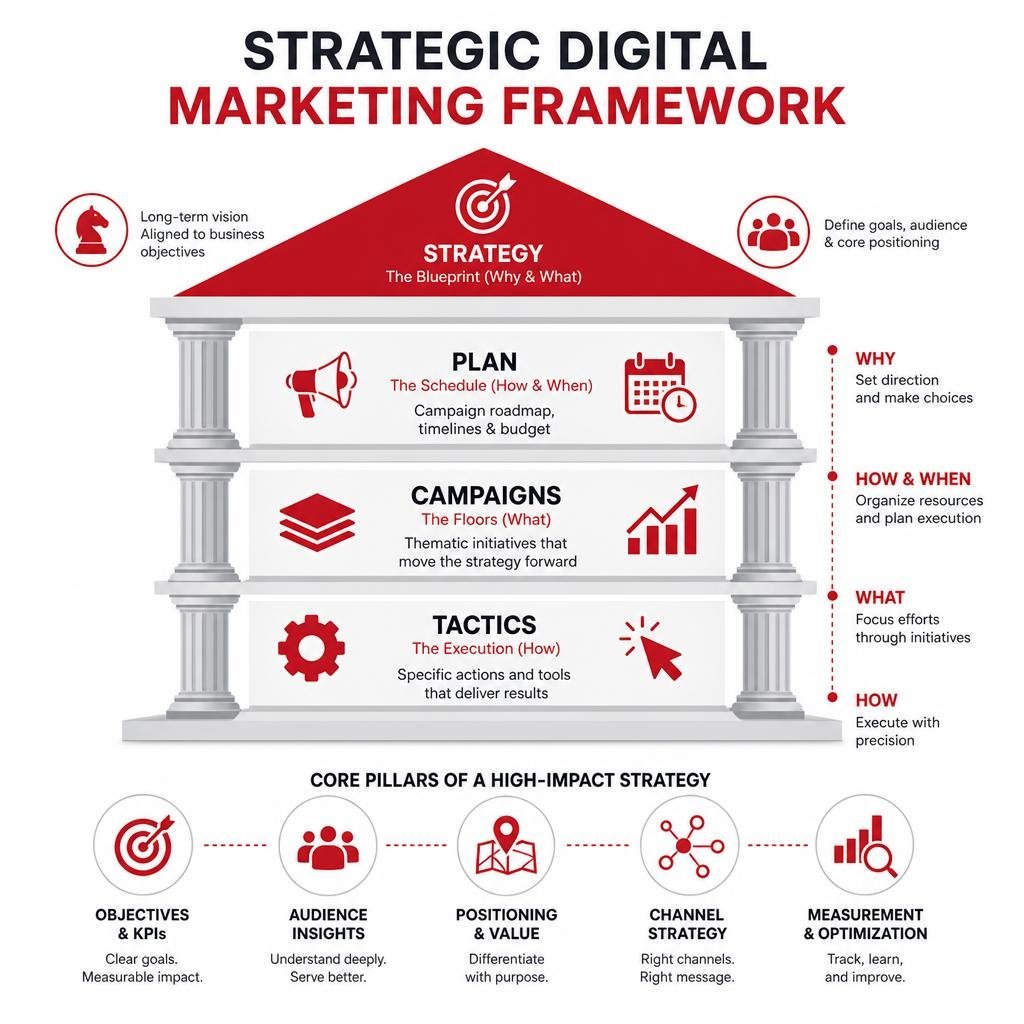
A digital marketing strategy serves as the overarching blueprint, a high-level, long-term roadmap (typically spanning months to years) that defines what a business aims to achieve, who it wants to reach, and why it will take specific actions. It aligns directly with broader business objectives, such as increasing market share, improving customer lifetime value, or launching a new product. Think of it as the architectural design for a building.
In contrast, marketing tactics are the individual tools and actions used to execute that strategy. These are the specific, short-term deliverables like creating a social media post, optimizing a webpage for a keyword, or launching a specific ad campaign. Using our building analogy, if the strategy is the blueprint, campaigns are the floors, and tactics are the interior design choices—the specific fixtures, paint colors, and furniture. A marketing plan then becomes the detailed schedule and budget for executing these tactics within specific campaigns. It outlines how and when these actions will be performed. Without a clear strategy, tactics can become busywork, generating high activity but minimal business impact.
Core Components of a High-Impact Strategy
A robust digital marketing strategy is built upon several foundational pillars that ensure all efforts are coherent and purposeful.
- Objectives and KPIs: Every strategy must begin with clear, measurable goals. These should be SMART (Specific, Measurable, Achievable, Relevant, Time-bound) and directly tied to business outcomes, not just vanity metrics. For instance, instead of “increase social media engagement,” a strategic objective might be “increase qualified lead generation by 15% through LinkedIn by Q4 2026.” Key Performance Indicators (KPIs) are then chosen to track progress toward these objectives.
- Audience Personas: Understanding who you are marketing to is non-negotiable. Detailed buyer personas go beyond demographics, delving into psychographics, pain points, motivations, online behaviors, and preferred communication channels. This deep understanding informs every aspect of your messaging and channel selection.
- Value Proposition: What unique value do you offer that solves your audience’s problems? A clear, compelling value proposition articulates why customers should choose you over competitors. This message hierarchy should be consistent across all digital touchpoints.
- Channel Strategy: This involves thoughtfully selecting the digital channels that align with your audience’s online habits and your strategic objectives. It’s about prioritizing where to invest your resources for maximum impact, rather than trying to be everywhere at once.
- Content Plan: Content is the fuel for most digital marketing efforts. A strategic content plan outlines the types of content (blogs, videos, infographics, case studies), topics, formats, and distribution channels, all mapped to buyer personas and stages of the customer journey.
- Budget and Resources: Realistic allocation of financial and human resources is critical. This includes not just ad spend, but also investments in technology, team training, and content creation.
- Governance: In an increasingly complex digital world, governance establishes clear rules for brand claims, customer consent, data access, and list hygiene. It ensures ethical practices and compliance with privacy regulations, especially as we move towards privacy-first marketing. A key aspect here is the collection and utilization of zero-party data, information that customers proactively and intentionally share with a brand, which becomes invaluable for personalized, trust-based marketing.
Deconstructing the SES Framework
To combat the overwhelming array of digital marketing options, a simplified approach can be incredibly effective. The SES framework—Search, Email, Social—offers a practical way to organize and prioritize your digital marketing efforts, mapping directly to how prospects move from initial discovery to becoming loyal advocates.
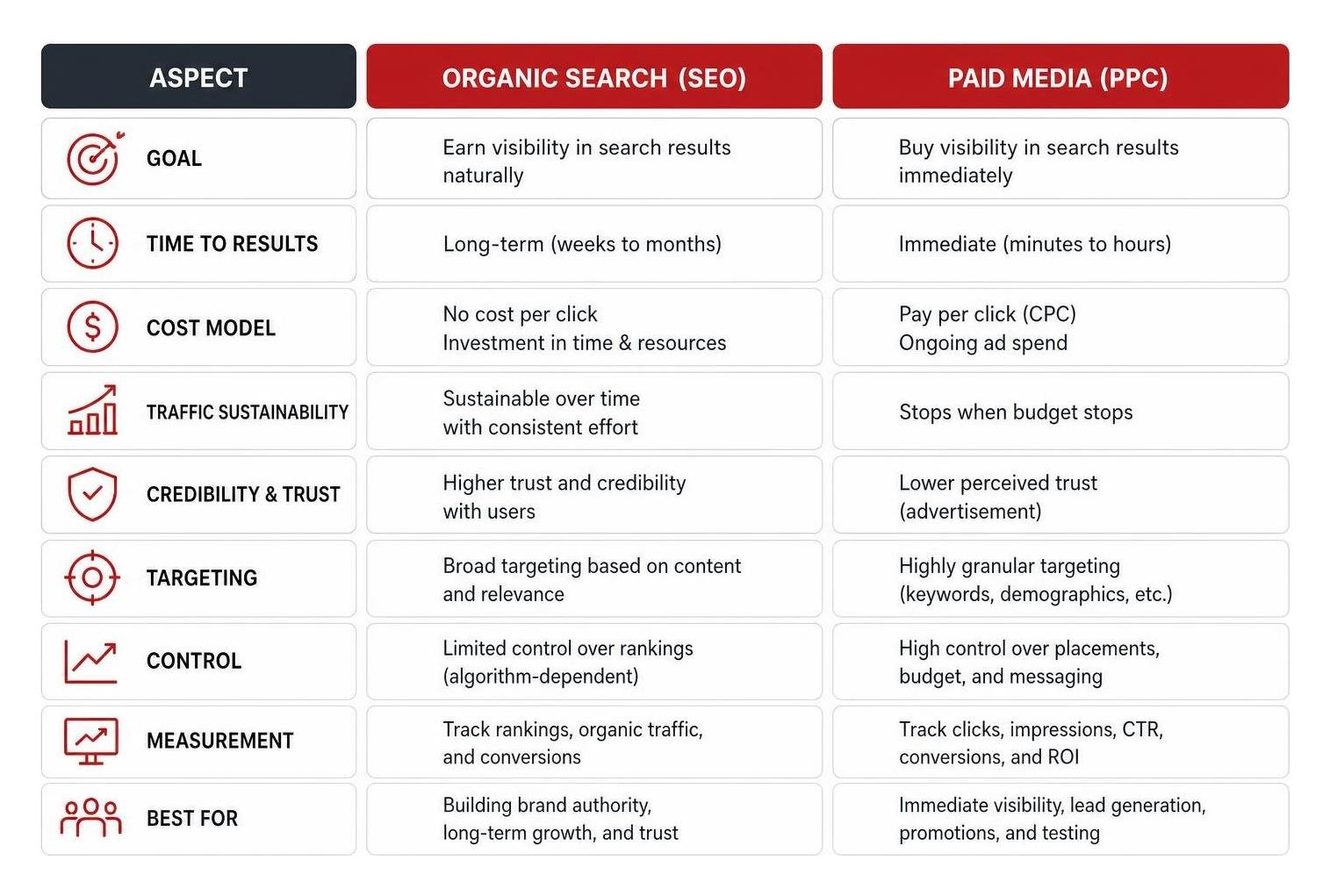
- Search (Discovery Engine): This pillar focuses on how potential customers find you when they are actively looking for solutions. It encompasses Search Engine Optimization (SEO) to rank organically in search results and Pay-Per-Click (PPC) advertising for immediate visibility. The goal here is to be present and discoverable at the moment of intent.
- Email (Owned Media Asset): Email represents the channel you truly own. Unlike social media platforms where algorithms dictate reach, your email list is a direct line to your audience. This pillar is crucial for nurturing leads, building relationships, driving conversions, and fostering customer loyalty. It’s where you deepen engagement and deliver personalized value.
- Social (Relationship and Advocacy Engine): Social media, while often seen as a discovery tool, is most powerful as a platform for building relationships, fostering community, and encouraging advocacy. It’s where your brand’s personality shines, where customers can interact directly, and where word-of-mouth marketing can amplify your reach.
By focusing on one strong “play” within each of these three pillars, businesses can build a sustainable customer acquisition funnel without being overwhelmed by choice. This framework helps connect the dots, ensuring that traffic from Search and Social is directed into your owned Email channel for deeper engagement and conversion, ultimately leading to customer advocacy back on social platforms.
Core Categories of Digital Marketing Strategies
Digital marketing encompasses a diverse ecosystem of channels, each with its unique strengths and applications. Effectively choosing and integrating these channels is central to a successful strategy. We often categorize digital media into three buckets:
- Owned Media: Channels controlled entirely by your brand, such as your website, blog, email list, and mobile apps. These provide stability and a direct connection with your audience.
- Paid Media: Channels where you pay for visibility, including PPC ads, social media ads, display ads, and influencer marketing. Paid media offers immediate reach and precise targeting.
- Earned Media: Recognition gained through third-party endorsements, such as PR mentions, organic social shares, reviews, and word-of-mouth. Earned media builds trust and credibility.
A balanced mix across these categories ensures a resilient and effective digital presence.
Search Engine Optimization and Answer Engine Visibility
Search Engine Optimization (SEO) remains a cornerstone of digital marketing, driving significant organic traffic to websites. Organic search accounts for over half of all trackable website traffic, making it an indispensable long-term investment. SEO involves optimizing your website’s content, technical structure, and authority to rank higher in search engine results pages (SERPs). This includes keyword research, on-page optimization, link building, and ensuring a fast, mobile-friendly user experience.
However, the landscape is rapidly evolving. With the rise of AI, particularly Google’s AI Overviews, the concept of Answer Engine Optimization (AEO) is becoming increasingly critical. When an AI summary appears in search results, clicks to traditional organic links can drop significantly. This means content must be optimized not just for ranking, but for providing direct, concise answers that AI models can easily extract and summarize. Our strategies must adapt to structure content with clear definitions, credible evidence, and standalone answers, ensuring visibility even when users don’t click through to a website. Technical SEO, including proper schema markup and site architecture, is more important than ever to help search engines and AI understand your content.
Performance Advertising and Search Marketing
Pay-Per-Click (PPC) advertising offers immediate visibility and highly targeted reach, making it a powerful component of many digital marketing strategies. Platforms like Google Ads and social media advertising allow businesses to place ads directly in front of their target audience based on keywords, demographics, interests, and behaviors.
The effectiveness of PPC lies in its measurable ROI. Continuous A/B testing of ad copy, visuals, and landing pages is essential to optimize performance and ensure every dollar spent generates maximum return. Retargeting campaigns, which show ads to users who have previously interacted with your brand, are particularly effective for nurturing leads and driving conversions. For businesses seeking to maximize their presence across search results, a strategy that combines organic efforts with paid advertising can yield powerful results. This approach often involves developing an integrated SEO and PPC strategy, ensuring that both long-term organic growth and immediate, targeted traffic goals are met efficiently.
Owned Channel Optimization and Email Nurturing
While rented channels like search and social media are vital for discovery, owned channels provide stability and control. Your website, blog, and especially your email list, are assets you fully control, free from algorithm changes or platform restrictions.
Email marketing, in particular, continues to deliver exceptional ROI, generating approximately $36 for every $1 spent. However, reaching the inbox is not guaranteed. A significant percentage of legitimate marketing emails fail to land in the inbox, highlighting the critical importance of email deliverability. This involves robust domain authentication using protocols like SPF (Sender Policy Framework), DKIM (DomainKeys Identified Mail), and DMARC (Domain-based Message Authentication, Reporting & Conformance). Domains fully authenticated with these measures are significantly more likely to reach their intended recipients.
Beyond deliverability, effective email nurturing involves segmenting subscribers, personalizing content, and automating workflows based on user behavior. From welcome sequences to re-engagement campaigns, email builds lasting relationships and guides customers through the sales funnel. Building a strong email list and maintaining its health is a fundamental aspect of a sustainable digital marketing strategy, complementing other efforts like robust online visibility and social engagement. For comprehensive digital presence, combining efforts in areas like SEO and social media management with email nurturing is key, often requiring expert guidance in managing your online visibility.
Key Frameworks for Building Digital Marketing Strategies
Building a digital marketing strategy requires a structured approach. It’s not just about picking channels, but about creating a cohesive system that works together to achieve business goals.

Tailoring Digital Marketing Strategies for Growth
The approach to building a digital marketing strategy must be tailored to the business’s size, industry, and specific goals.
For a small business, resources are often limited, making focus paramount. Instead of attempting to be everywhere, a small business should identify its ideal customer and focus on one strong play within each of the SES pillars (Search, Email, Social). This might mean optimizing their Google Business Profile for local search, using a simple lead magnet to build an email list, and consistently engaging on a single social media platform where their target audience is most active. The emphasis is on deep execution in a few key areas rather than a thin presence across many.
Enterprise-level organizations, with larger budgets and more complex structures, often require a more sophisticated approach. This involves integrating digital marketing across various departments, aligning with Revenue Operations (RevOps) to ensure seamless handoffs between marketing, sales, and customer service. Resource distribution becomes more intricate, often involving specialized teams for SEO, PPC, content, and social media. Competitive positioning is also a continuous effort, requiring constant monitoring and adaptation to market shifts. For enterprises, the strategy isn’t just about customer acquisition but also about customer retention, advocacy, and maximizing customer lifetime value across a vast customer base.
Step-by-Step Execution and Quarterly Reviews
Regardless of business size, a systematic approach to strategy execution and review is essential:
- Conduct a Marketing Audit: Before setting new goals, assess current performance. Analyze traffic sources, conversion paths, and sales objections. Identify what’s working and what’s not.
- Define SMART Goals: Based on your audit and business objectives, set clear, measurable goals.
- Develop Buyer Personas and Value Proposition: Refine your understanding of your audience and how your offerings uniquely solve their problems.
- Prioritize Channels and Resources: Select the most impactful channels and allocate budget and team resources accordingly.
- Create a Content Plan and Messaging Hierarchy: Map content to personas and channels, ensuring consistent messaging that resonates.
- Implement and Track KPIs: Launch your campaigns and meticulously track the KPIs identified in step 2. Use dashboards to monitor performance in real-time.
- Quarterly Reviews and Optimization: Digital marketing is not a set-it-and-forget-it endeavor. Conduct quarterly reviews to evaluate performance against goals, identify funnel leaks, and adapt to new trends or market changes. This continuous optimization cycle is vital for sustained success.
Navigating AI and Data Privacy Trends
The digital marketing landscape is perpetually in flux, and two of the most significant forces shaping its future in 2026 are Artificial Intelligence (AI) and the increasing emphasis on data privacy. These trends are not merely technological advancements but fundamental shifts that demand strategic adaptation.

AI’s Transformative Impact
AI is profoundly reshaping how digital marketing strategies are conceived and executed.
- AI Search Summaries: As mentioned earlier, AI Overviews are changing search behavior. Marketers must optimize content for direct answers and focus on building owned channels to mitigate potential traffic loss to AI summaries. This means creating highly authoritative, useful, and concise content that AI can trust and synthesize.
- Agentic AI Workflows: Beyond basic chatbots, agentic AI is emerging. These autonomous AI agents can analyze subscriber behavior, write email subject lines, adjust send times, and even manage parts of the sales process, significantly enhancing personalization and efficiency. This shift moves from rule-based automation to AI-driven decision-making, requiring marketers to understand how to integrate and manage these intelligent systems.
- Content Creation and Personalization: AI-powered tools are assisting in generating content ideas, drafting copy, and personalizing experiences at scale. This allows marketers to produce more relevant content faster, but it also elevates the importance of human oversight to ensure quality, originality, and brand voice.
Privacy-First Marketing and Zero-Party Data
With increasing consumer awareness and stricter regulations (like GDPR and CCPA), data privacy is no longer optional—it’s a strategic imperative. The move towards a privacy-first world means:
- Reduced Reliance on Third-Party Data: The phasing out of third-party cookies and stricter data sharing policies necessitate new approaches to audience targeting and measurement.
- Emphasis on Zero-Party Data: Brands must actively seek data directly from consumers through transparent value exchanges. This includes preference centers, interactive quizzes, and direct feedback. This data is willingly shared, highly accurate, and builds trust, forming the foundation for ethical personalization.
- Consent and Transparency: Marketing strategies must be built on explicit consent and clear communication about how data is collected and used. This fosters a stronger, more trusting relationship with customers.
Navigating these trends requires marketers to be agile, continuously learning, and willing to experiment with new technologies and ethical data practices.
Key Performance Metrics and Pitfalls to Avoid
Measuring success is critical for any digital marketing strategy. While specific KPIs will vary based on objectives, some universal metrics and common pitfalls deserve attention:
Key Performance Indicators (KPIs):
- Customer Acquisition Cost (CAC): The total cost of acquiring a new customer.
- Customer Lifetime Value (LTV): The total revenue a business can expect from a single customer account.
- Return on Ad Spend (ROAS): Revenue generated for every dollar spent on advertising.
- Conversion Rate: The percentage of users who complete a desired action (e.g., purchase, sign-up).
- Website Traffic & Engagement: Quality of traffic, time on site, bounce rate.
- Email Deliverability & Open Rates: Ensuring emails reach the inbox and are engaged with.
Pitfalls to Avoid:
- Vanity Metrics: Focusing on metrics like social media likes or impressions that don’t directly correlate with business objectives.
- Channel Overload: Spreading resources too thin across too many channels, leading to mediocre performance everywhere.
- Lack of Strategy: Executing tactics without a clear, overarching plan, resulting in disjointed efforts.
- Ignoring Data: Failing to analyze performance data and adapt the strategy accordingly.
- Poor Email Deliverability: Neglecting technical aspects of email sending, leading to low inbox placement and wasted effort.
- Static Strategy: Failing to adapt to evolving trends like AI and privacy regulations.
Enterprise Success Stories in Marketing Execution
Examining how well-known brands leverage digital marketing offers valuable insights into effective strategy implementation. These examples showcase how diverse strategies can drive growth across different business models.
- Adobe (B2B Software): Adobe’s digital marketing strategy for its enterprise software (e.g., Adobe Experience Cloud) focuses heavily on content marketing, thought leadership, and personalized experiences. They create in-depth research reports, whitepapers, and webinars targeting specific B2B personas, positioning themselves as industry experts. Their strategy involves sophisticated lead nurturing through email automation, targeted account-based marketing (ABM) campaigns, and leveraging their own platform’s analytics to optimize customer journeys. This multi-channel approach ensures they capture high-intent leads and build long-term relationships with businesses.
- Nike (E-commerce & D2C): Nike’s strategy is a masterclass in direct-to-consumer (D2C) engagement and brand building. They excel at social media marketing with visually stunning campaigns and influencer collaborations, fostering a strong community around their brand. Their mobile app (Nike Training Club, SNKRS) drives loyalty through exclusive content, personalized recommendations, and gamified experiences. Email marketing is used for product launches and personalized offers, while a strong SEO strategy ensures high visibility for product searches. Nike’s success lies in its ability to create emotional connections and seamless omnichannel experiences.
- Zoom (SaaS): Zoom’s meteoric rise was fueled by a highly effective digital marketing strategy that capitalized on the remote work trend. Their strategy focused on robust SEO for high-intent keywords related to video conferencing and remote collaboration. They produced extensive content (guides, tutorials, blog posts) addressing user pain points and showcasing their platform’s ease of use. A freemium model facilitated rapid user acquisition, while targeted PPC campaigns captured users actively searching for solutions. Their social media presence highlighted user stories and practical applications, contributing to viral growth.
- Airbnb (B2C & Platform): Airbnb’s digital marketing strategy thrives on user-generated content and local SEO. They encourage hosts to create compelling listings with high-quality photos, which serves as authentic marketing material. Their social media showcases aspirational travel experiences and unique stays, leveraging visual storytelling. Local SEO efforts ensure they appear in search results for specific destinations and experiences. Email marketing is used for personalized recommendations, booking confirmations, and re-engagement campaigns. Airbnb effectively uses its community to drive discovery and trust, fostering a sense of belonging for both hosts and guests.
These examples underscore the importance of aligning digital marketing efforts with overall business goals and customer understanding.
Frequently Asked Questions about Digital Marketing Strategies
We often encounter similar questions from businesses looking to refine their online presence. Here are some of the most common ones:
What is the main difference between a digital marketing strategy and a marketing plan?
A digital marketing strategy defines the overarching, long-term direction and vision for your online efforts. It answers what you want to achieve and why. A marketing plan, on the other hand, is the actionable roadmap that outlines how you will execute that strategy, detailing specific tactics, timelines, budgets, and responsibilities. The strategy is the blueprint, the plan is the construction schedule.
What is the SES framework in digital marketing?
The SES framework stands for Search, Email, Social. It’s a simplified model that organizes digital marketing efforts into three core pillars, each representing a crucial stage in the customer journey:
- Search: How customers discover your brand (SEO, PPC).
- Email: Your owned channel for nurturing leads and building relationships.
- Social: Where relationships and advocacy happen, fostering community and brand loyalty. This framework helps businesses prioritize and focus their efforts without getting overwhelmed by the multitude of available channels.
How often should a company update its digital marketing strategy?
While the core foundations of a digital marketing strategy might hold for 1 to 3 years, it’s crucial to review and adjust it more frequently. We recommend a quarterly review to assess performance against KPIs, identify emerging trends, and make necessary pivots. Significant technological shifts, like the increased role of AI or changes in data privacy regulations, also necessitate immediate strategic adaptations, ensuring your yearly overviews remain relevant and effective.
Conclusion
In the rapidly evolving digital landscape of August 2026, a well-defined digital marketing strategy is no longer a luxury but a necessity for sustainable growth. We’ve explored how a strategic blueprint differs fundamentally from mere tactics, providing the clarity needed to navigate the complexities of online engagement. By understanding the core components of a high-impact strategy—from detailed buyer personas to robust governance—and leveraging frameworks like SES, businesses can build a cohesive and effective online presence.
The impact of emerging trends like AI and privacy-first data demands continuous adaptation, pushing us to optimize for answer engines and prioritize zero-party data. Measuring success through relevant KPIs and proactively avoiding common pitfalls ensures that every effort contributes to tangible business outcomes. By embracing strategic alignment, committing to sustainable growth, and maintaining adaptive execution, any business can harness the immense power of digital marketing to connect with its audience, drive conversions, and build lasting success.