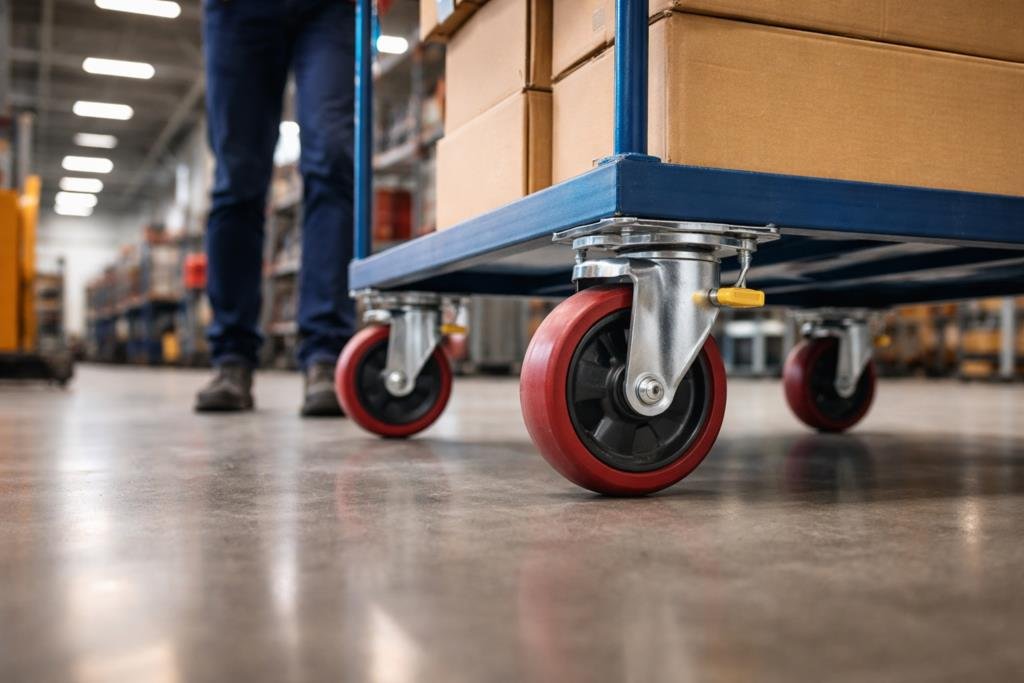
Factory floor efficiency is shaped by countless small decisions that collectively influence productivity, safety, and operating costs. While machinery, automation, and layout planning often receive the most attention, one foundational element is frequently underestimated: the caster setup used to move equipment, carts, racks, and mobile workstations. The choice of caster and swivel casters directly affects how smoothly materials flow, how much effort workers expend, and how often operations are disrupted by maintenance or downtime.
Selecting the right caster setup is not simply about adding wheels to equipment. It requires a thoughtful evaluation of load requirements, movement patterns, floor conditions, safety considerations, and long-term operational impact. Balancing these factors involves trade-offs, and overlooking any one of them can compromise factory efficiency instead of improving it.
The Role of Casters in Factory Floor Operations
In an industrial environment, a Caster is more than a mobility accessory. It is a mechanical component that must perform reliably under repetitive stress, heavy loads, and sometimes harsh conditions. Casters enable flexibility by allowing equipment to be repositioned quickly, production lines to be reconfigured, and materials to be transported without fixed conveyors or forklifts.
Swivel casters add an additional layer of maneuverability. By rotating 360 degrees, they allow equipment to change direction easily, which is especially valuable in tight spaces or dynamic layouts. However, this increased maneuverability can introduce challenges related to control, stability, and alignment, particularly when loads are heavy or travel distances are long.
Efficiency gains from casters are most noticeable when they reduce friction, minimize push and pull force, and allow workers to move loads safely and predictably. When casters are poorly matched to the application, the opposite occurs—workers struggle with resistance, carts veer off course, and productivity suffers.
Load Capacity and Its Impact on Performance
One of the most critical factors in caster selection is load capacity. Industrial environments often involve uneven weight distribution, dynamic loads during movement, and occasional impact forces. A caster that meets the static load requirement may still fail under real-world operating conditions if dynamic forces are not considered.
Using a caster with insufficient load capacity can lead to premature wear, bearing failure, or deformation of the wheel material. These failures increase maintenance costs and disrupt workflow when equipment must be taken out of service. On the other hand, over-specifying casters by choosing significantly higher load ratings than necessary can increase initial costs and sometimes reduce maneuverability due to harder wheel materials.
Swivel casters introduce additional considerations, as the swivel mechanism itself must handle both vertical and lateral forces. Heavier loads place more stress on the swivel bearing, which can increase rolling resistance if not properly designed. Balancing load capacity with ease of movement is a key trade-off that directly influences factory efficiency.
Maneuverability Versus Directional Control
One of the most common decisions in caster setup design involves choosing between fixed casters, swivel casters, or a combination of both. Fixed casters provide directional stability and are well suited for long, straight travel paths. Swivel casters excel in tight spaces where frequent turning is required.
In many factories, a mixed configuration is used, such as two fixed casters paired with two swivel casters. This setup offers a compromise between maneuverability and control, allowing carts to track straight while still being able to turn when needed. However, this balance is not universal and depends heavily on how equipment is used.
Using too many swivel casters can make heavy loads difficult to control, especially on slopes or uneven floors. Carts may drift sideways, increasing the risk of collisions or injuries. Conversely, relying too heavily on fixed casters can make repositioning equipment slow and physically demanding. The challenge lies in understanding the movement patterns on the factory floor and selecting a caster setup that aligns with them.
Floor Conditions and Environmental Challenges
Factory floors vary widely, ranging from smooth epoxy coatings to rough concrete surfaces with debris, joints, or slopes. Floor conditions significantly influence how a caster performs and how much effort is required to move a load.
Hard wheel materials may roll efficiently on smooth surfaces but transmit vibration to equipment and operators. Softer wheels can absorb shock and reduce noise, but they may wear faster or increase rolling resistance. Swivel casters, in particular, are sensitive to floor irregularities, as debris or cracks can interfere with swivel rotation and lead to sudden resistance or misalignment.
Environmental factors such as moisture, chemicals, temperature extremes, and cleanliness standards also play a role. Casters used in food processing or pharmaceutical facilities must withstand frequent washdowns, while those in manufacturing plants may need resistance to oils, metal shavings, or abrasive dust. Selecting a caster without considering these conditions can result in frequent replacements and reduced efficiency over time.
Ergonomics and Worker Fatigue
Efficiency is closely tied to human performance. If workers must exert excessive force to move equipment, fatigue sets in more quickly, increasing the risk of errors and injuries. Proper caster selection can significantly reduce the physical strain associated with pushing, pulling, and steering loads.
Rolling resistance is a critical factor in ergonomics. High-quality casters with appropriate wheel materials and bearing systems reduce the force required to initiate and maintain movement. Swivel casters, when properly specified, can improve ergonomics by allowing smoother turns and reducing awkward repositioning.
However, ergonomic benefits can be undermined if casters are poorly maintained or mismatched to the application. Worn wheels, damaged bearings, or misaligned swivel mechanisms increase resistance and negate the intended efficiency gains. This highlights the importance of viewing caster setup as part of a broader ergonomic and maintenance strategy.
Safety Considerations and Risk Management
Safety is an essential component of factory efficiency. Accidents and near-misses disrupt operations, damage equipment, and affect employee morale. Casters play a direct role in safety by influencing stability, braking, and load control.
Swivel casters can introduce safety challenges if not properly managed. Uncontrolled rotation can cause carts to change direction unexpectedly, especially when starting or stopping movement. Braking systems and directional locks can mitigate these risks but add complexity and cost.
The trade-off between safety and flexibility is an important consideration. Adding brakes or locks improves control but may slow down workflows if they are cumbersome to engage. Conversely, prioritizing speed over control can increase the likelihood of accidents. An effective caster setup balances these concerns by aligning safety features with actual usage patterns.
Maintenance, Durability, and Lifecycle Costs
Initial purchase price is only one part of the total cost of a caster setup. Maintenance requirements, replacement frequency, and downtime all contribute to the true cost of ownership. Casters that require frequent servicing or fail unexpectedly can erode efficiency gains and increase long-term expenses.
Swivel casters, with their additional moving components, often require more attention than fixed casters. Bearings must remain clean and lubricated, and swivel mechanisms must be inspected for wear or misalignment. In high-use environments, neglecting maintenance can quickly lead to performance degradation.
Investing in durable casters designed for industrial use can reduce maintenance demands, but this often involves higher upfront costs. The challenge is determining where higher-quality components provide a meaningful return on investment. For critical equipment or high-traffic areas, durability often outweighs initial cost considerations.
Layout Flexibility and Operational Adaptability
Modern factories increasingly value flexibility. Product lines change, workflows evolve, and space must be reconfigured to meet new demands. Casters support this adaptability by enabling mobile workstations, modular storage, and reconfigurable production areas.
Swivel casters are particularly valuable in flexible layouts, as they allow equipment to be repositioned quickly without complex material handling systems. However, flexibility must be balanced with stability, especially for precision operations or heavy machinery.
A poorly planned caster setup can undermine adaptability if equipment becomes difficult to control or requires frequent adjustments. Considering future layout changes during caster selection helps ensure that mobility solutions remain effective as operational needs evolve.
Decision-Making and Long-Term Impact
Choosing the right caster setup requires a holistic approach that considers immediate operational needs as well as long-term impact. Decisions should account for productivity, worker well-being, safety, maintenance, and adaptability. Focusing too narrowly on a single factor, such as cost or maneuverability, often leads to unintended consequences.
The impact of caster decisions extends beyond individual carts or workstations. Across an entire factory floor, small inefficiencies multiply, affecting throughput, labor costs, and equipment lifespan. Conversely, a well-designed caster strategy can deliver incremental improvements that add up to meaningful gains in efficiency.
Final Thoughts
Improving factory floor efficiency with the right caster setup is a nuanced process that involves balancing multiple, sometimes competing, factors. Load capacity, maneuverability, floor conditions, ergonomics, safety, and maintenance all influence how casters perform in real-world industrial environments. Swivel casters offer valuable flexibility, but they must be selected and configured thoughtfully to avoid compromising control or stability.
By taking a comprehensive and objective approach to caster selection, industrial facilities can enhance productivity, reduce worker fatigue, and minimize downtime. The true value of the right caster setup lies not only in improved mobility, but in its lasting impact on operational efficiency, safety, and adaptability across the factory floor.