Key Takeaways:
- Exchange-traded funds (ETFs) and mutual funds are both popular investment vehicles, each with unique features.
- ETFs offer advantages such as lower expense ratios, tax efficiency, and the ability to trade intraday.
- Mutual funds may offer benefits such as active management and no trading commissions.
- Understanding the differences can help investors make informed decisions aligned with their financial goals.
Introduction
Choosing how to invest can feel daunting with the wide range of investment options available today. Among the most popular choices are Exchange-Traded Funds (ETFs) and mutual funds. While both offer a way to diversify across various assets, they have distinct features that cater to different types of investors. Understanding the key distinctions is critical for building a portfolio that aligns with your personal investment strategy. For a comprehensive overview and side-by-side comparison, check out this guide on ETFs vs mutual funds.
People are often drawn to mutual funds due to their professional management and the ability to invest with small amounts automatically. Meanwhile, ETFs are gaining ground thanks to their intraday liquidity and cost advantages. Both can be pillars in a well-balanced investment approach, particularly in an era where flexibility and efficiency matter more than ever.
Whether you are an experienced investor or just starting, understanding the fundamental differences between ETFs and mutual funds is essential for maximizing returns while aligning with your risk tolerance and investment timeline. Before deciding where to put your money, consider how these differences impact costs, taxes, trading strategies, and overall portfolio management.
Understanding ETFs and Mutual Funds
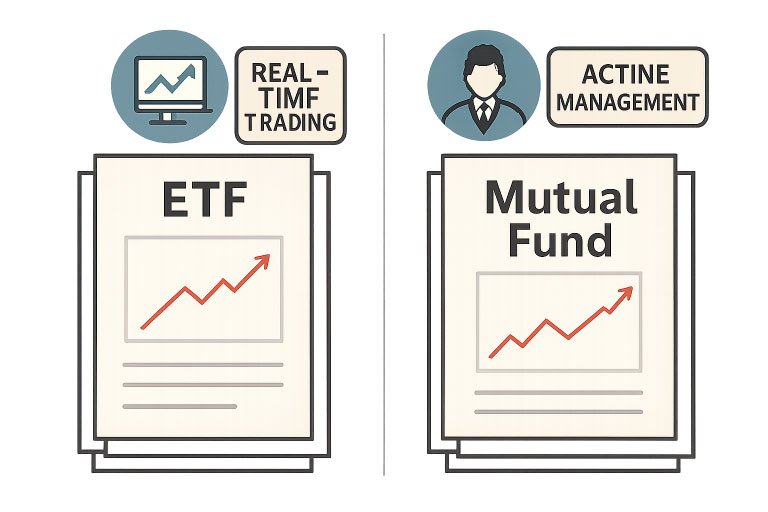
ETFs and mutual funds are both pooled investment funds, but they differ in their structure and operation. ETFs are typically designed to passively track a broad market index or sector, and their shares trade like stocks on exchanges throughout the day. This means investors can buy or sell ETF shares at market prices at any time while the exchange is open, benefiting from intraday price fluctuations and opportunities.
On the other hand, mutual funds aggregate money from many investors and are often actively managed. A fund manager selects securities with the intention of outperforming a benchmark or achieving specific investment objectives. Shares in a mutual fund are bought or redeemed directly through the fund company or an intermediary, with transactions executed just once per business day at the fund’s net asset value (NAV).
Key Differences Between ETFs and Mutual Funds
- Trading Mechanism: ETFs are traded on stock exchanges and can be bought or sold at market prices during trading hours. In contrast, mutual funds execute trades only once daily, after the market closes, at the set NAV.
- Expense Ratios: ETFs typically have lower expense ratios than mutual funds, particularly when compared to actively managed mutual funds. Over time, lower fees can have a significant positive impact on investment returns.
- Tax Efficiency: ETFs are typically more tax-efficient due to their in-kind creation and redemption process, which minimizes capital gains distributions to shareholders. In contrast, mutual funds may trigger more taxable events when adjusting their portfolios to meet redemptions.
Cost Considerations
Fees can erode investment returns over the long term, making expense ratios and other costs one of the most important considerations. As Morningstar data highlights, index ETFs typically charge around 0.44%, while comparable index mutual funds average approximately 0.88%. Although the numbers might seem small, the long-term impact on compounded returns is significant. Additionally, many brokerages have eliminated trading commissions for most ETFs, making them even more cost-effective.
Investors should also consider other potential costs, such as sales loads (entry or exit fees often associated with mutual funds), and bid-ask spreads for ETFs. Evaluating all costs is crucial before making a decision.
Tax Efficiency
Tax implications are another area where ETFs often have an advantage. The unique “in-kind” creation and redemption process behind ETFs allows managers to swap out securities without triggering taxable events. This tax-efficient system helps to minimize, and sometimes avoid, the unwanted surprise of capital gains distributions that can occur with mutual funds—especially when large investors redeem their shares and require managers to sell underlying securities.
Trading Flexibility
ETF investors benefit from real-time pricing and liquidity, enabling them to respond instantly to market news or volatility. This feature is especially valuable for sophisticated investors who want to use limit orders, stop-loss orders, or buy on margin. By contrast, mutual fund investors can only buy or sell at the end-of-day NAV price, which can mean missing out on intraday opportunities or being forced to accept values that have changed significantly during the trading day.
Performance and Management Styles
A key difference between mutual funds and many ETFs is their management style. Most mutual funds are actively managed, with expert fund managers seeking to “beat the market.” This active approach often comes with higher fees but may provide peace of mind to investors who prefer to leave asset selection to professionals. Many ETFs, meanwhile, are physically or synthetically constructed to track an index passively. This passive structure tends to result in lower fees and benchmark-consistent returns, but may lack the potential upside (and downside) of an actively managed strategy.
Final Thoughts
ETFs and mutual funds both offer unique benefits, serving as foundational building blocks for investors with varying goals, risk tolerances, and investment styles. While ETFs often stand out for their lower costs, tax efficiency, and trading flexibility, mutual funds are compelling for investors who prefer hands-off, actively managed solutions or features like automatic investments. Understanding these differences empowers you to make more informed decisions and build a portfolio that helps you achieve your long-term financial ambitions.